Back to Mechanics
Mechanics WikiVerified April 17, 2026

Stars

Stars are Regent's persistent secondary resource. They do not reset at turn end and they have no cap, which enables Regent's infinite Stars/Energy conversion builds.

Regent Stars card preview in Slay the Spire 2
An official Regent Stars preview keeps the explanation concrete and easy to follow.

Stars are Regent's persistent secondary resource, displayed in the lower-left of the energy bar. Unlike energy, Stars do not reset at the start of your turn and do not refill automatically — every Star must be earned from a card effect.

Regent's entire kit pivots on that single rule. Cards that pay out in Stars are cheap for what they do, finishers like Seven Stars and Meteor Shower spend Stars in bulk, and power cards like Child of the Stars and Black Hole trigger every time a Star enters or leaves your pool.

Verification note

Based on Mega Crit's December 11, 2025 Regent reveal combined with NamuWiki's Regent card database and community A10 clear reports from Gamersky.

Why Stars matters

If you are seeing Stars for the first time, start with the rule. That is the fastest way to make sense of the fights, cards, and choices built around it.

Once the basic rule clicks, the related links show you where Stars starts changing real decisions in a run.

Learn the rule before you worry about ranking or build theory.

Open the related guides if Stars changes pathing, card picks, or early-act risk.

Come back after major updates if wording, balance, or examples change.

Baseline Star rules

Stars have no cap, no decay, and no starting value. You begin each combat with 0 Stars and only earn them when a card says 'gain Stars.' NamuWiki's Regent database states the resource value precisely: 3 Stars is worth about 2 Energy when you compare cards that spend Stars against cards that spend Energy for similar output.

There is one subtle wording rule players trip on. If a card says 'play without cost,' both its Energy and Star costs become 0. If a card says 'cost becomes 0 Energy,' only the Energy cost drops — you still pay the full Star cost. Big Bang and Quasar copies behave differently because of this wording.

Cards that generate Stars

Venerate is Regent's fourth starter and the first Star faucet you will see: 1 cost, gain 3 Stars, replaces a generic starter slot. Glow is the uncommon centerpiece at 1 cost, gain 1 Star and draw 2 cards (patched to 1 draw + next-turn 1 draw in v0.100.0 beta). Gather Light splits block and a Star on the same 1 cost card at 7 block / 10 upgraded.

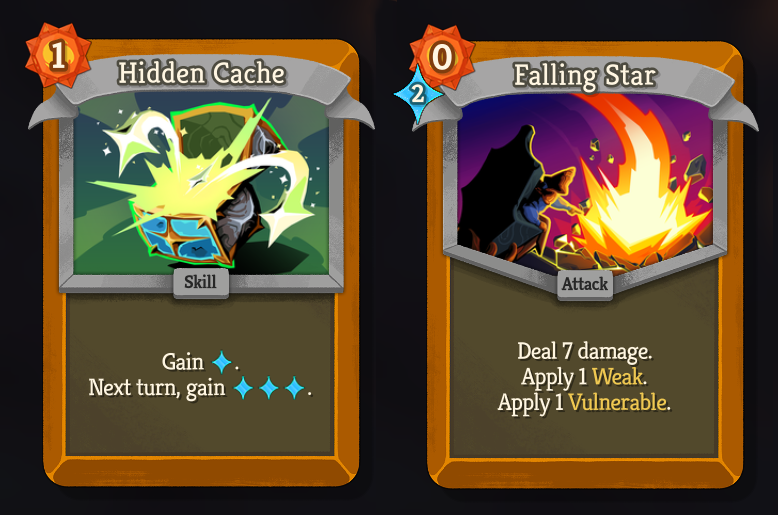
Hidden Cache is the gain-next-turn variant, and Convergence is the 2-cost skill that stores Energy and a Star for next turn while Retaining your hand. At the rare end, Big Bang is the 0-cost card that draws 1, grants Energy and Stars, applies Forge 5, then exhausts — it is the single most-wanted Star engine piece in the class.

  • Venerate — starter, 1 cost, gain 3 Stars
  • Glow — 1 cost, gain 1 Star + draw 2 (nerfed to 1+1 in v0.100.0)
  • Gather Light — 1 cost, 7/10 block + gain 1 Star
  • Convergence — 2 cost, next-turn Energy + Star, Retains hand
  • Big Bang — rare 0-cost, draw 1 + Star + Energy + Forge 5, exhaust
  • Sealed Throne — ancient power, gain Stars on every card played (innate upgrade)
  • Monologue — skill, +1 Strength per card used this turn (Retain on upgrade)

Cards that spend Stars for damage

Seven Stars is Regent's signature AoE finisher: 7 damage × 7 hits = 49 total, cost 2 Energy (upgrades to 1) and consumes 7 Stars. Comet is the single-target bomb at 33 damage plus 3 Weak and 3 Vulnerable, upgrades to 44 damage with the same debuffs. Meteor Shower is the ancient AoE at 14 damage to all + 2 Weak + 2 Vulnerable, upgrades to 21 damage.

Radiate is the scaling AoE that deals 3 damage (4 upgraded) to all enemies per Star you gained this turn. Crescent Spear is the 1-cost attack that does 6 damage plus 2 extra per Star-cost card still in your deck (3 upgraded). Dying Star is Volatile: 9 damage AoE plus enemies lose 9 Strength this turn (11/11 upgraded).

  • Seven Stars — 2→1 cost, 7×7 = 49 AoE, spends 7 Stars
  • Comet — rare 2-cost, 33/44 damage + 3 Weak + 3 Vulnerable
  • Meteor Shower — ancient 3-cost, 14/21 AoE + Weak + Vulnerable
  • Radiate — 1 cost, 3 damage AoE per Star gained this turn (4 upgraded)
  • Crescent Spear — 1 cost, 6 damage + 2 per Star-cost card (3 upgraded)
  • Dying Star — rare, Volatile, 9 AoE + enemies lose 9 Strength this turn

Power cards that turn Stars into a loop

Three powers convert Stars into a feedback loop strong enough to win Ascension 10 runs. Child of the Stars grants 2 block (3 upgraded) every time you consume a Star, which turns Seven Stars into a 14-block swing on the spot. Black Hole deals 3 AoE damage (4 upgraded) every time you gain or consume a Star, so a 7-Star spend triggers 7 separate AoE pulses.

Alignment is the skill that converts stored Stars into Energy, and the Sealed Throne ancient power adds a Star every time you play any card. Stacking Alignment with Sealed Throne on a draw engine is the A10 infinite-stars shell that Gamersky's tommyya17 guide documents — Astrae Sequence plus Glow plus Alignment cycle through the deck until you spike with Seven Stars.

  • Child of the Stars — 2 block per Star consumed (3 upgraded)
  • Black Hole — 3 AoE damage per Star gained or consumed (4 upgraded)
  • Alignment — spend stored Stars to gain Energy
  • Furnace — Forge 4 at turn start (6 upgraded)
  • Genesis — gain Stars at the start of each turn
  • Sealed Throne — ancient, gain Stars on every card played (innate on upgrade)

A10 infinite-stars build

Gamersky's A10 clear report from author tommyya17 names the build: two Glow, one Astrae Sequence (rare), one Alignment, and enough filtering (Cosmic Indifference, Prophesize, Glimmer) to recycle draws. Glow gains the Star and draws 2 to fetch Alignment; Alignment converts banked Stars to Energy to cast the next Glow. Cost-reduction relics like Red Bull plus Radiate or Stardust convert the loop into a whirlwind-style AoE.

Author abrahamiltion's tier analysis adds three key relic flags: Royal Seal turns Particle Wall into a one-card defense, Mirror duplicates one broken card like Decisions, and Europans is the S-tier Ancient pairing for Regent because it offers Meteor Shower and upgrades to starter relics. Without at least one rare Star generator, the deck never crosses the break-even point and collapses on Ascension 9+.

Common Star pitfalls

The first mistake is spending Stars on the first available finisher. Seven Stars without Child of the Stars or Black Hole in play is a 49 AoE that does nothing for defense or scaling. Save your stored Stars for the turn a power is active or the boss is Vulnerable.

The second mistake is mixing Stars with Forge. Forge is a Regent sub-theme that builds up Sovereign Blade damage — it does not consume Stars and does not benefit from Child of the Stars, Black Hole, or Alignment. NamuWiki's archetype list names Stars, Forge, and Minion as three separate decks; a Forge card slot is a Star-deck slot you did not take.

Comparison

How this differs from Slay the Spire 1

Stars are one of the clearest examples of the sequel introducing a new class resource rather than only remixing old attack-skill-power logic.

FAQ

Do Stars disappear at the end of the turn?

No. NamuWiki confirms Stars persist across turns, do not decay, and do not automatically refill. Every Star must be earned from a card effect.

Is there a cap on Stars?

No. The Regent reveal and the NamuWiki database both state there is no cap on Stars. A prepared Regent deck can stockpile double-digit Star pools for a spike turn.

How much is a Star worth compared to Energy?

NamuWiki's Regent page states the conversion: 3 Stars is roughly worth 2 Energy when you compare cards that spend each resource for similar output.

Why do some free-play effects still cost Stars?

Wording matters. 'Play without cost' zeroes both Energy and Star costs. 'Cost becomes 0 Energy' only zeroes the Energy cost — you still pay every Star the card requires.

What is the Seven Stars combo worth?

Seven Stars deals 7 damage × 7 hits = 49 AoE at 2 Energy and 7 Stars. With Child of the Stars that also grants 14 block. With Black Hole that adds 7 extra AoE pulses. Upgraded, the Energy cost drops to 1.

Do Stars carry over after combat?

No. Stars persist across turns within a combat but reset between combats. Map your Star accumulation to the current fight only.

Should I mix Stars and Forge in one run?

Avoid it. Forge scales Sovereign Blade separately from Stars and does not interact with Child of the Stars, Black Hole, or Alignment. NamuWiki treats them as separate archetypes for a reason.