Back to Mechanics
Mechanics WikiVerified April 17, 2026

Forge

Forge is Regent's delayed-payoff archetype. The first Forge each combat creates a Retain colorless attack called Sovereign Blade, and every later Forge stack increases that blade's damage.

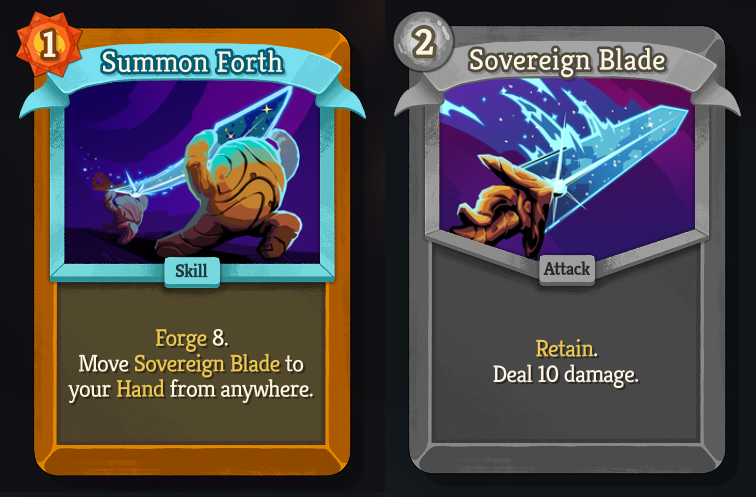
Regent Forge card preview in Slay the Spire 2
Forge deserves its own visual because it is one of the terms returning players have no prior context for.

Forge is Regent's single-hit-spike archetype. The first card with Forge you play each combat creates Sovereign Blade in your hand — a 2-cost colorless attack with Retain, base damage 10. Every later Forge X you trigger permanently increases that Blade's damage by X for the rest of the fight.

That rule unlocks an entire Regent sub-class that NamuWiki lists as the Forge Deck, separate from the Stars Deck. A mature Forge build wins turn-one boss rooms on Ascension 10 by banking 40-80 Forge across early turns and then hitting with a 50+ damage Retained Blade.

Verification note

Based on Mega Crit's December 11, 2025 Regent reveal and NamuWiki's Regent database, which documents the exact Sovereign Blade creation rule, Forge stacking behavior, and Forge-deck card list.

Why Forge matters

If you are seeing Forge for the first time, start with the rule. That is the fastest way to make sense of the fights, cards, and choices built around it.

Once the basic rule clicks, the related links show you where Forge starts changing real decisions in a run.

Learn the rule before you worry about ranking or build theory.

Open the related guides if Forge changes pathing, card picks, or early-act risk.

Come back after major updates if wording, balance, or examples change.

Sovereign Blade creation and scaling rules

The first Forge X you trigger each combat creates Sovereign Blade in your hand as a 2-cost colorless attack that deals 10 damage, has Retain, and never leaves your hand across turns. Every subsequent Forge X adds X to Sovereign Blade's current damage. The Blade tracks this value wherever it lives — hand, discard, or draw pile — and hovering the mouse on it shows the current damage.

If you copy Sovereign Blade with an effect like Heirloom Hammer (17 damage + copy one colorless in hand), every copy inherits the current Forge total and scales together going forward. Exhausting a Sovereign Blade does not lock the total: subsequent Forge triggers still scale any exhausted copies, so stacking exhaust-and-reforge loops produces a field of floating blades even though only one is actually playable.

The essential Forge card list

NamuWiki names four cards as essential to the Forge Deck: Summon Forth, Bulwark, The Smith, and Sword Sage. Summon Forth is the uncommon 2-cost skill that fetches Sovereign Blade from any pile and applies Forge 8 (11 upgraded) — this is the deck's reliability card because without it Retain is your only way to see the Blade. Bulwark is 2-cost, gain 13 block (16 upgraded), Forge 10 (13 upgraded), which doubles as defense and scaling.

The Smith is the rare skill that does nothing but Forge 30 (40 upgraded). Sword Sage is the rare power that makes Sovereign Blade cost 1 more but hit one extra time — turning a 50 damage Blade into a 50×2 = 100 damage single card. Without Sword Sage the Forge ceiling is roughly capped by boss HP; with it, the ceiling jumps above 200 per play.

  • Wrought in War — 1 cost, 7/9 damage + Forge 5/7
  • Refine Blade — 1 cost, Forge 6/10 + next-turn Energy
  • Spoils of Battle — 1 cost, Forge 10/15
  • Bulwark — 2 cost, 13/16 block + Forge 10/13
  • Summon Forth — 2 cost, Forge 8/11 + fetch Sovereign Blade
  • Conqueror — 2 cost, Forge 3/5 + Sovereign Blade deals 2× damage this turn
  • Beat into Shape — rare, 5/7 damage + Forge 5/7 + extra Forge per other attack this turn
  • The Smith — rare skill, Forge 30/40
  • Seeking Edge — rare power, Forge 7/11 + Sovereign Blade hits all enemies
  • Furnace — power, Forge 4/6 at turn start
  • Sword Sage — rare power, Sovereign Blade cost +1 but hits +1 time
  • Parry — power, gain 6/9 block on Sovereign Blade play

Why Stars and Forge do not mix

NamuWiki's archetype section draws a hard line between Stars Deck and Forge Deck. The Stars Deck wants Child of the Stars and Black Hole to trigger on every Star gain/spend; a Forge card does not generate Stars and is a dead slot next to those powers. Forge decks instead want Parry (block per Blade hit) and Sword Sage (extra hit), which do nothing in a Stars build.

The two archetypes also want different relics. Forge wants Swordsmanship Manual (Sovereign Blade gets +3 damage on first draw of combat), Sharp Tooth (attacks hit harder), and plating/block relics to buy time while Forge stacks. Stars wants Mini Regent, Moon Cake, and Galaxy Dust. Mixing produces a deck that is mediocre at both rather than elite at one.

Opening the Forge Deck

Forge has a long warm-up. Turn 1 in Act 1 plays a cheap Forge card — Wrought in War at 1 cost (7 damage + Forge 5) — to spawn Sovereign Blade with 15 damage. Turn 2 plays Refine Blade or Spoils of Battle to move the Blade to roughly 25-30 damage. By turn 3 or 4 you can hit with a 30-40 damage Retained attack for 2 Energy, and from there The Smith or Seeking Edge cross the 50-damage line.

Act 2 punishes this warm-up. NamuWiki specifically flags Ghost Knight, Kaiser Crab, and Stealth Swarm as Forge's worst matchups because they either reflect, shield, or swarm before you can spike. Route around those fights with Bulwark + Glitterstream for block, and save The Smith upgrades for boss rooms where the warm-up is survivable.

Ceiling combos worth learning

The keystone combo is Summon Forth + The Smith + Sword Sage on a single turn: Forge 8 + Forge 30 stacks onto a Sovereign Blade that already has a baseline, then Sword Sage converts the play into two hits. Against a boss with 3 Vulnerable from Falling Star, a 45-damage Blade hits for 67 per swing × 2 = 134 in one play.

The runner-up combo is Conqueror before a banked Blade. Conqueror applies Forge 3 (5 upgraded) and makes Sovereign Blade deal 2× damage this turn only. Stacking Conqueror+ onto a 40-damage Blade immediately converts into an 80-damage 2-Energy Retain attack, and it stays at 40 for the next turn. Beat into Shape is the multiplier tail — Forge 5 baseline plus Forge 5 per other attack this turn, which stacks cleanly after a Seven Stars spike.

Mistakes that kill a Forge run

The first mistake is playing Sovereign Blade too early. At 10-15 base damage it is strictly worse than your common Regent attacks, so unless the Blade would be wasted (enemy almost dead, Blade about to be exhausted), Retain it and keep stacking. The Blade is a finisher, not a tempo card.

The second mistake is over-pruning attacks. A Forge deck still needs at least two baseline attacks (Photon Cut at 10/13 damage or Astral Pulse at 14/18 AoE) to survive turns where Sovereign Blade has not yet reached breakpoint. Skipping attacks entirely in favor of Forge-only cards leaves turn 1 and turn 2 with no output, which Ascension elites punish.

Comparison

How this differs from Slay the Spire 1

Forge matters because it turns a familiar concept, making cards better, into a class-facing keyword rather than only a campfire decision or one-off effect.

FAQ

Does every Forge card make Sovereign Blade?

Only the first Forge trigger each combat creates Sovereign Blade. Every later Forge stack adds its X value to the existing Blade's damage. If the Blade is Transformed or destroyed, a new Forge creates a reset Blade.

What does Sovereign Blade cost and how much does it hit for?

Sovereign Blade is a 2-cost colorless attack with Retain. Base damage is 10. Each Forge X you trigger adds X to the Blade's damage for the rest of the combat. Sword Sage upgrades the cost to 3 but makes the Blade hit +1 time.

Can I keep Forging an exhausted Sovereign Blade?

Yes. NamuWiki confirms Forge scaling still applies to Sovereign Blade copies in the exhaust pile. Stacking Forge triggers after exhausting a Blade visibly increases the surrounding floating-blade count even though only one Blade is playable.

Is Forge on any character besides Regent?

No. Every printed Forge card in the current database sits in Regent's class pool. Colorless and status cards do not carry Forge.

What is the biggest Forge card?

The Smith — a rare skill that does nothing but Forge 30 (40 upgraded). It is the single largest Forge stack on any card and the primary reason Forge Decks run rare-scouting relics.

Which enemies hard-counter a Forge Deck?

NamuWiki names Ghost Knight, Kaiser Crab, and Stealth Swarm as Forge's worst matchups. They either reflect Sovereign Blade damage back, apply shields that neutralize single-spike plays, or swarm so fast that the Forge warm-up cannot finish.

Can I mix Forge with a Stars build?

Not effectively. Forge cards do not generate Stars, and Stars powers like Child of the Stars or Black Hole do not trigger on Forge. NamuWiki treats Stars Deck and Forge Deck as mutually exclusive archetypes with different essential cards and different relic lists.