Back to Mechanics
Mechanics WikiVerified 2026-04-17

Alternate Acts

Alternate Acts are Slay the Spire 2's route-level branching system. Each act has two biome variants with distinct enemies, events, elites, and bosses. Act 1 is Overgrowth or Underdocks; Acts 2 and 3 have their own confirmed splits.

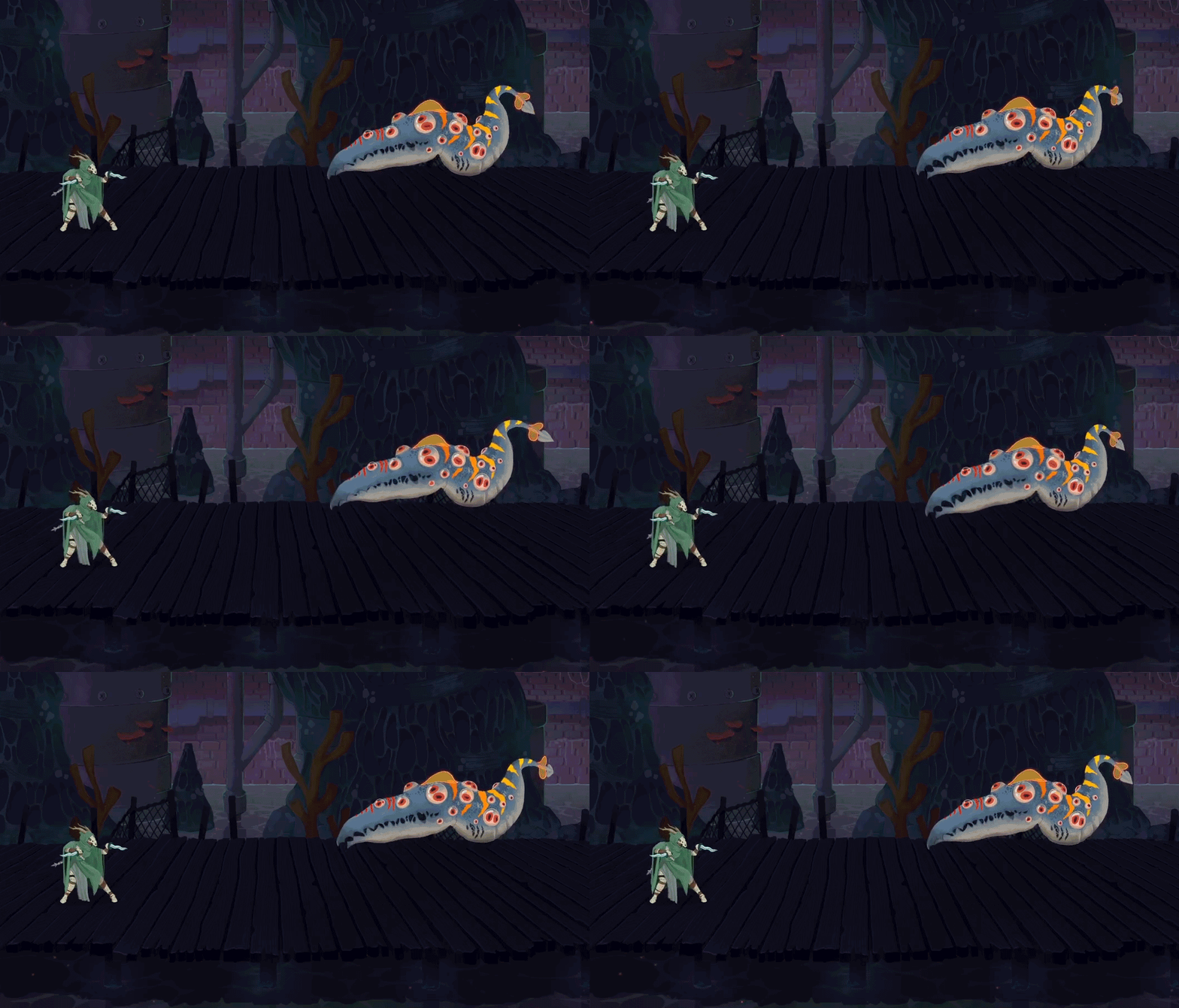
Slay the Spire 2 alternate act preview showing the Underdocks route
Mega Crit's alternate-act preview is the best one-shot visual for the Overgrowth and Underdocks split.

Alternate Acts are Slay the Spire 2's answer to repeat-run fatigue. Each act has two biome variants, randomized per run after unlock. The variants share the same progression slot (Act 1, Act 2, Act 3) but swap the entire enemy pool, events, elites, and boss encounters.

Mega Crit's Neowsletter #14 confirmed the Act 1 split: Overgrowth (a verdant forest biome) vs. Underdocks (a dark, flooded harbor biome). The same reveal promised Act 2 and Act 3 alternates during Early Access — those are now live as of v0.102.0.

This page catalogs which bosses, elites, and signature enemies belong to which biome, so you can read the loading screen and know immediately what to expect.

Verification note

Officially revealed by Mega Crit on September 11, 2025 (Neowsletter #14). Boss-to-biome assignments verified against NamuWiki monster data and in-game encounter logs from March-April 2026.

Why Alternate Acts matters

If you are seeing Alternate Acts for the first time, start with the rule. That is the fastest way to make sense of the fights, cards, and choices built around it.

Once the basic rule clicks, the related links show you where Alternate Acts starts changing real decisions in a run.

Learn the rule before you worry about ranking or build theory.

Open the related guides if Alternate Acts changes pathing, card picks, or early-act risk.

Come back after major updates if wording, balance, or examples change.

Act 1 — Overgrowth vs. Underdocks

Act 1 Overgrowth is the forest biome — Mega Crit's replacement for the first game's Exordium. Expect Leaf Slimes, Phrog Parasites, and Myte-family Poison mobs. The signature Act 1 Overgrowth boss is the Ceremonial Beast (252/262 HP), a Nemesis-tagged fight with three distinct phases.

Act 1 Underdocks is the dark harbor biome — sea-themed enemies including Haunted Ship (63/67 HP), Noisebot, and the Inklings that lead up to Vantom (173/183 HP) as their boss. Soul Fysh (211/221 HP) can appear as the alternate Act 1 Underdocks boss in some run-seeds.

  • Overgrowth — Forest biome. Signature enemies: Leaf Slimes, Phrog Parasite + Wriggler, Myte, Illusionists. Boss: Ceremonial Beast (252 HP, 3-phase Nemesis).
  • Underdocks — Dark harbor biome. Signature enemies: Haunted Ship (63 HP, steals cards), Noisebot, Inklings (Slippery 9), Sawtooth. Bosses: Vantom (173 HP, Ink-themed, gains Str via Prepare) or Soul Fysh (211 HP, Lure Afflictions).
  • Which biome is harder — Overgrowth is easier for beginners because Ceremonial Beast has predictable phase transitions. Underdocks's Vantom is community-rated the hardest Act 1 boss because the Slippery 9 + Injury-adding pattern hard-counters multi-hit decks.
  • Routing tip — if you see Overgrowth, lean into multi-hit/combo decks. If you see Underdocks, prioritize single-hit burst and Injury removal.

Act 2 — The Mid-Climb Branches

Act 2 biomes were added in post-launch patches. The two variants swap elite pools entirely: one biome emphasizes Affliction-heavy elites (Hunter Killer, Lagavulin Matriarch), the other emphasizes high-HP brawlers (Waterfall Giant, Kin Priest).

Act 2 bosses confirmed in v0.102.0 include Kaiser Crab, Knowledge Demon, and The Insatiable (321/341 HP, instant-death sand-pit mechanic). Each boss is biome-gated — The Insatiable only appears in the desert/subterranean variant.

  • Biome A elites — Hunter Killer (121 HP, Tenderizing Goop Weak), Lagavulin Matriarch (222 HP, sleeps 3 turns then Soul Siphon).
  • Biome B elites — Waterfall Giant (250 HP, Pressurize self-destruct), plus a second Biome B elite rotated in by act variant.
  • Bosses — Kaiser Crab (armor focus), Knowledge Demon (card-manipulation focus), The Insatiable (321 HP, sand-pit insta-kill on turn counter). Biome assignment randomizes per run.
  • The Insatiable's sand-pit — reaches 0 and overrides all resurrection relics (Fairy in a Bottle, Lizard Tail) for an instant Game Over. Desperate Escape Status cards increase the timer but cost +1 Energy each use.
  • v0.102.0 change — the double-beetle encounter was removed from the Act 2 encounter pool, making Biome A significantly more forgiving.

Act 3 — The Final Biome Split

Act 3 has two biome variants with four confirmed bosses split across them: Doormaker (489/512 HP), The Queen (400 HP), Torch Head (199 HP), and Test Subject #C10. Each biome gets two of the four, and Phase 3 (300/313 HP, triggered by certain boss fights) acts as a secondary encounter inside the biome.

Doormaker is the most mechanically complex Act 3 boss with a 3-turn Affliction cycle (Hunger → Scrutiny → Grasp). Queen, Torch Head, and Test Subject #C10 don't apply Afflictions but trade that for higher raw damage output.

  • Doormaker (489/512 HP) — 3-turn cycle: Hunger (12×2 + Exhaust Affliction) → Scrutiny (30 damage + draw prevention) → Grasp (Str+4 + Str/Dex -1 to you).
  • The Queen (400 HP) — high HP pool, summons minions. No Afflictions; test of raw sustain damage.
  • Torch Head (199 HP) — Inkblot boss (30 damage + 3 Status cards turn 1). Extends Vantom's Inkling pattern into Act 3.
  • Test Subject #C10 — science-lab aesthetic. Full pattern varies; Mega Crit has not published complete data.
  • Phase 3 (300/313 HP) — triggered sub-boss with Lacerate (10×3), Big Pounce (45 damage), and Burning Growl (Str +2 + 3 Burns). Nemesis-tagged with Invulnerability 1.

How to Read the Biome Signal Before Committing to a Route

When you arrive at the start of a new act, the act's name and art on the loading screen telegraph the biome. Because each biome has a fixed elite and boss pool, seeing 'Overgrowth' instead of 'Underdocks' tells you exactly which Act 1 boss you'll fight.

Use this signal to shape your Act N-1 drafts. If you know Act 2 will be Biome A (Affliction-heavy), prioritize Artifact relics and card removal in late Act 1. If you know Act 2 will be Biome B (raw-damage focus), prioritize Block and burst-damage cards.

  • Loading screen name — fastest signal. Check before committing to the first elite fight.
  • Music cue — each biome has distinct audio. Overgrowth uses woodwind-driven themes; Underdocks uses low brass and water-splash SFX.
  • Enemy encounter text — Act 2 Biome A fights name-reference 'goop,' 'hunt,' or 'sleep.' Biome B fights reference 'pressure,' 'stomp,' or 'matriarch.'
  • Boss preview — end of Act N shows the next act's boss lineup on the map. Alternate Act biome locks in only after you enter, so you can't preview which biome appears until loading.

Unlock Progression and Run Variance

Alternate Acts unlock through the Epochs/Timeline progression system. New players start with Overgrowth only for Act 1 — Underdocks unlocks after completing a full Act 1 run.

Variance across 10 consecutive runs: the community-tracked distribution settles at roughly 50/50 between biome variants per act slot, so expect 5/10 Overgrowth runs on average. This balances practice repetitions against the goal of keeping runs fresh.

  • Act 1 unlock — Overgrowth available immediately; Underdocks after first full Act 1 completion (any character).
  • Act 2 unlock — both biomes unlock after reaching Ascension 1 (completing the base game with a character).
  • Act 3 unlock — both biomes unlock alongside Ascension 1 completion.
  • Epoch rewards — some Alternate Act unlocks are gated behind Epoch manual-claim rewards. Check your Epoch tracker for unclaimed items.
  • Repeat probability — subsequent runs get both biomes as equal-chance random picks. Streaks of 3+ consecutive same-biome runs are possible but statistically uncommon.

Why Alternate Acts Matter for Deck Building

STS1 pathing advice assumed one Act 1, one Act 2, one Act 3. STS2 breaks that assumption: your deck isn't solving 'Act 2' — it's solving Biome A or Biome B. Draft priorities diverge.

Example: Silent Poison decks score above-average win rates against Act 2 Biome B (Waterfall Giant has no Artifact) but below-average against Biome A (Hunter Killer's Tenderizing Goop Weak stalls Noxious Fumes stacking). A good Silent deck picks which biome it can beat before committing.

  • Ironclad — strong in Overgrowth (Ceremonial Beast rewards Strength scaling). Weaker in Underdocks (Vantom's Slippery 9 invalidates multi-hit Heavy Blade).
  • Silent — balanced; biome-specific Poison issues flip between Act 2 biomes.
  • Defect — strong in Act 3 Doormaker (Grasp's Str/Dex debuff doesn't hurt Orb damage). Weak vs. Soul Fysh (Lure Status cards).
  • Necrobinder — Doom ignores most biome-specific debuffs, so Necrobinder plays more consistently across biomes than any other character.
  • Regent — strongest in Act 3 Torch Head (Retained Sovereign Blade chews Inkblot phases). Weakest vs. Act 2 Insatiable (sand-pit ignores boss-execution Doom mechanics).

Comparison

How this differs from Slay the Spire 1

Alternate Acts are a direct answer to a first-game limitation: veterans could talk about acts as stable destinations more often than the sequel seems to want.

Officially confirmedStructure

Fixed act slots vs branch-specific acts

Slay the Spire 1

Act 1, Act 2, and Act 3 each had a more stable identity in the original climb.

Slay the Spire 2

Act slots can branch into different versions such as Overgrowth and the Underdocks.

Why it matters

Route advice now has to care about the actual branch, not just the act number.

Officially confirmedStructure

Known enemy pools vs larger route variance

Slay the Spire 1

Veterans often carried strong expectations about the enemies and bosses waiting in a given act.

Slay the Spire 2

Mega Crit says alternate acts vary in enemies, events, bosses, and even presentation.

Why it matters

That makes repeat-run planning less deterministic at the act-label level.

More mechanics

FAQ

Are Alternate Acts available from the first minute?

No. Act 1 Overgrowth is available immediately, but Underdocks unlocks after completing your first full Act 1 run on any character. Act 2 and Act 3 alternate biomes unlock alongside Ascension 1 progression. Mega Crit gates them this way so new players meet one biome before the system randomizes.

Do Alternate Acts only change the background art?

No. Each biome variant has a completely different enemy pool, elite pool, event pool, and boss pool. Overgrowth and Underdocks share zero enemy types. Audio (music and SFX) also differs. The only shared element is the act-level progression (N rooms, 1 elite-heavy path, 1 boss).

Which Act 1 biome is harder?

Underdocks. Vantom (173/183 HP) combines Slippery 9 (incoming damage capped to 1 per hit) with Injury-adding attacks that poison your deck — this hard-counters multi-hit decks like Defect Claw and Silent Shivs. Overgrowth's Ceremonial Beast (252/262 HP) is predictable by comparison because each phase telegraphs the next. Community win-rate data backs this out: Overgrowth averages 5-8 percentage points higher win rate across Ascensions.

Can I choose which biome to enter?

No. Biome assignment is random per run once both variants are unlocked for that act slot. The only indirect control is the Seeded Run mode, where a seed value determines the biome deterministically. In normal runs, treat the biome as a coin flip revealed at the act transition.

Will more Alternate Acts arrive later?

Not committed. Mega Crit's original plan was two biomes per act, and v0.102.0 delivers that. Casey Yano's April 2026 Kotaku interview didn't name additional biomes in the pipeline — the next post-launch content will likely be new characters and new game modes instead. Treat the current 2-biome-per-act structure as the final state unless Mega Crit announces otherwise.

How do I see which biome I'm heading into?

The loading screen between acts names the biome and shows biome-specific art. The act transition screen also displays the bosses available in that biome. You can't preview before triggering the transition — biome selection locks in at the transition moment, not before. Plan your late-act-N deck around handling either possible biome.