Back to Mechanics
Mechanics WikiVerified 2026-04-17

Afflictions

Afflictions are enemy-applied penalties that attack your deck instead of your HP bar. They come in two forms: status cards injected into your draw pile, and debuffs that strip Strength, Dexterity, or prevent actions.

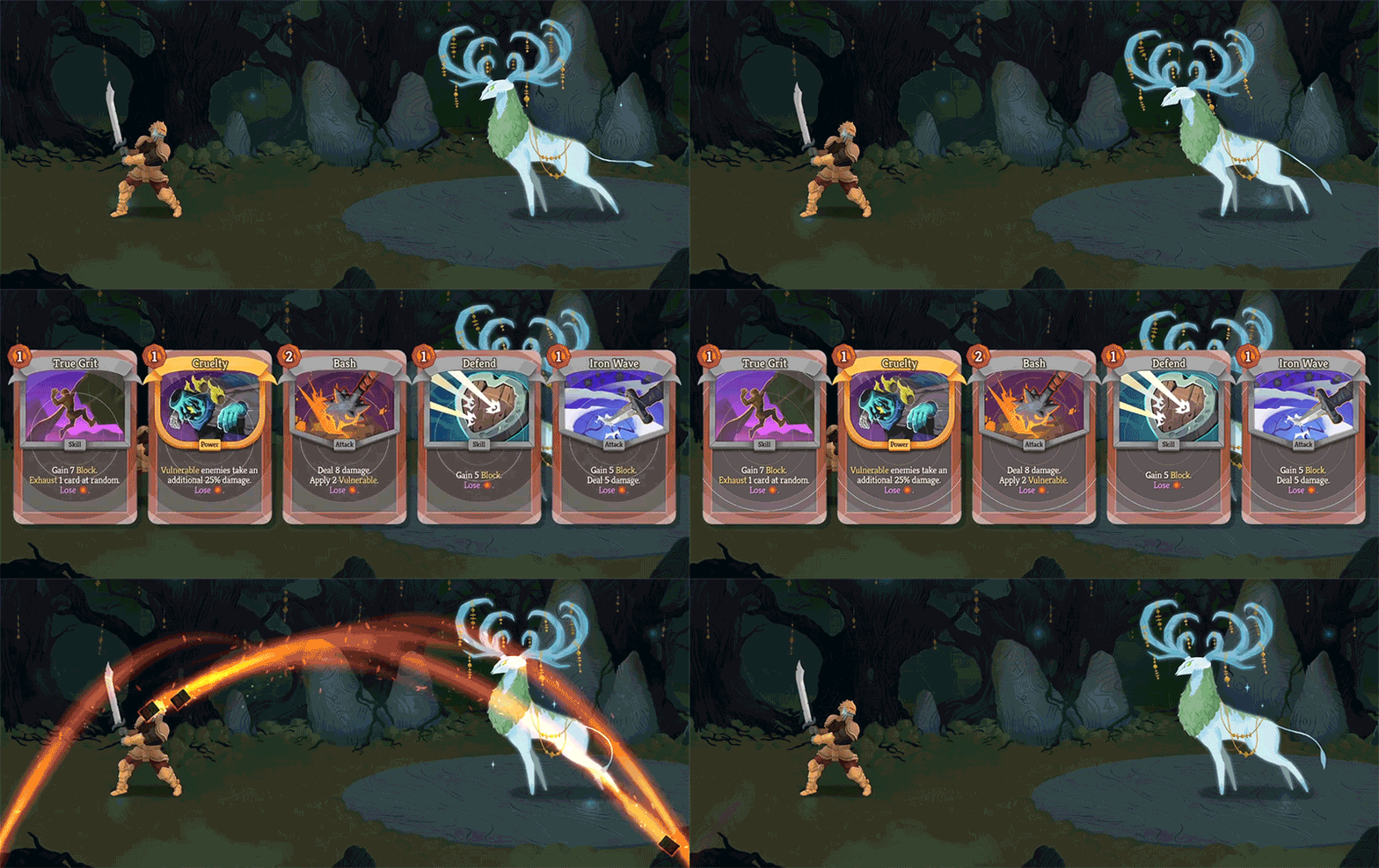
Slay the Spire 2 Afflictions preview showing cards being afflicted during combat
Mega Crit's Afflictions preview is the cleanest visual for explaining how this new debuff layer changes deck management.

Mega Crit introduced Afflictions in Neowsletter issue 9 (April 15, 2025) as a way for enemies to attack your deck directly. Unlike STS1 curses, Afflictions are combat-scoped most of the time — an enemy applies them mid-fight to force you to play around broken draw order or debuffed attacks.

There are two functional categories. Status-card Afflictions inject dead cards (Lure, Desperate Escape, Slimed, Debris) into your deck for the fight. Stat Afflictions apply Strength/Dexterity debuffs or draw-prevention effects. Both categories ignore HP totals, which is why Affliction-heavy enemies feel different from regular damage fights.

This page enumerates every confirmed Affliction-applying enemy, exactly which Affliction each applies, and the counter-play card pool available to each character.

Verification note

Officially revealed by Mega Crit on April 15, 2025. Enemy-specific Affliction patterns verified against NamuWiki monster data (HP and pattern numbers exact).

Why Afflictions matters

If you are seeing Afflictions for the first time, start with the rule. That is the fastest way to make sense of the fights, cards, and choices built around it.

Once the basic rule clicks, the related links show you where Afflictions starts changing real decisions in a run.

Learn the rule before you worry about ranking or build theory.

Open the related guides if Afflictions changes pathing, card picks, or early-act risk.

Come back after major updates if wording, balance, or examples change.

Two Types of Afflictions — Status Cards vs. Stat Debuffs

The first category is the classic STS1 "Slimed" pattern. An enemy adds unplayable or harmful cards (Status cards) into your draw or discard pile, diluting your deck for the rest of the fight. Examples include Soul Fysh's Beckon (Lure), Insatiable's Desperate Escape, and Gunk Up's Slimed.

The second category is a stat-level debuff. Doormaker's Grasp lowers Strength and Dexterity by 1, Lagavulin Matriarch's Soul Siphon reduces Strength and Dexterity by 2, and Hunter Killer's Tenderizing Goop applies Weak. These don't touch your draw pile but they neuter the cards you've already drawn.

  • Status-card Afflictions — diluted draw pile. Counters: card removal, Exhaust, hand discard.
  • Stat-debuff Afflictions — reduced damage/block from already-drawn cards. Counters: Artifact, dispel effects, burst cards that ignore Strength (Silent's Poison).
  • Draw-denial Afflictions — Doormaker's Scrutiny prevents drawing next turn. Counters: Retain keyword, hand retention, pre-draw setup.
  • Exhaust Afflictions — Doormaker's Hunger adds Exhaust tag to every card drawn on the affected turn. Counters: Dark Embrace, Feel No Pain, Shrug It Off synergies.

Every Enemy That Applies Afflictions

The NamuWiki monster index confirms 6 enemies and bosses that apply distinct Afflictions in v0.102.0. Each has a specific pattern window that lets you pre-empt the Affliction with the right counter.

Memorize the pattern order for each — bosses cycle Afflictions on predictable turns, so you can line up Apparitions, Block, or a burst turn against the window.

  • Hunter Killer (121/126 HP elite) — Tenderizing Goop on turn 1 (fixed), applies Weak. Passive ability also reduces your Strength/Dexterity by 1 per card played that turn, which counters low-cost spam decks.
  • Lagavulin Matriarch (222/233 HP elite) — Soul Siphon on turn 4 (pattern: Slash → Disembowel → Slash 2 → Soul Siphon → repeat), reduces your Strength and Dexterity by 2, gains 2 Strength. Sleeps turns 1-3 — use that window for pre-fight setup.
  • Soul Fysh (211/221 HP boss) — Beckon (Lure) on turns 1 and 3, adds Lure Status cards that deal HP loss (not damage) when drawn. Block is useless against Lure triggers; only HP-preservation relics help.
  • The Insatiable (321/341 HP Act 2 boss) — Liquify Ground on turn 1 adds 3 Desperate Escape Status cards to both draw and discard piles. Each use of Desperate Escape increases its cost by 1 — a compounding tempo drain.
  • Doormaker (489/512 HP Act 3 boss) — Hunger on turn 1 (12×2 damage + next Hunger converts to Scrutiny), Scrutiny on turn 2 (30 damage + prevents next-turn draw), Grasp on turn 3 (Strength +4, applies Strength -1 and Dexterity -1 to you, then resets to Hunger). 3-turn cycle.
  • Gunk Up (Defect card user — Status Applier mobs) — Adds Slimed Status cards to discard pile on every play (1 per hit × 3 = 3 Slimed total).

Status-Card Afflictions in Detail

Status-card Afflictions inject specific unplayable or harmful cards into your deck. Each has its own text and scaling, so 'Status card' isn't one thing — it's a category of 5+ distinct cards enemies can give you.

The Soul Fysh's Lure is the most dangerous because it causes HP loss directly (ignoring Block) when drawn. Every other Status Affliction reduces tempo but can be played around with card draw.

  • Lure (Soul Fysh) — unplayable, HP loss when drawn. Direct HP damage, ignores Block. Ironclad is most vulnerable (low HP pool), Silent is least (smallest draw count).
  • Desperate Escape (Insatiable) — 1E (rising), attacking card, each use adds sand-pit timer. Defect's Flak Cannon exhausts them for 8 damage each; Ironclad's Second Wind Exhausts them for Block.
  • Slimed (Gunk Up + Slime enemies) — 1E, Exhaust, no effect. Compounds in Defect Orb decks via Trash to Treasure and Smokestack. In other decks, removal is the only answer.
  • Debris (Regent self-generated) — 1E, Exhaust, no effect. Not enemy-applied but counts as a Status for mechanic purposes. Charge!!!! (Regent) removes them for 0 cost.
  • Void (Silent + self-generated via TURBO) — Unplayable, ends turn early if drawn as last card. Rare enemy-applied instance.

Counter-Play by Character

Each character has a specific Affliction counter. Some are better at stat-debuff counterplay (Silent Poison ignores Strength), some are better at Status-card counterplay (Defect Compact, Ironclad Dark Embrace).

If you're on Ascension 15+ and know your run will face Doormaker or Soul Fysh, prioritize the right counter card in Act 2 drafts.

  • Ironclad — Exhaust engine (Feel No Pain, Dark Embrace, Shrug It Off) turns Status Afflictions into triggers. Limit Break / Heavy Blade decks are hardest-countered by Doormaker's Grasp debuff.
  • Silent — Poison ignores Strength debuffs. Catalyst and Noxious Fumes pre-apply Poison before Doormaker reaches Grasp turn. Weak but handles stat Afflictions best.
  • Defect — Compact (1E, turn all Status in hand into Fuel) is the single best anti-Status card. Orb decks ignore Strength debuffs, so Doormaker's Grasp doesn't matter.
  • Necrobinder — Exhaust density counters Status Afflictions naturally. No Escape damage scales with Doom, which ignores Strength.
  • Regent — Forge decks work on Retained damage, so Strength matters less. Charge!!!! removes Status cards. Seven Stars (persistent Stars) bypasses debuffs entirely.

Visual Markers and the Turn-Timer

Afflictions are marked visually on the card frame. When an enemy applies an Affliction, the affected card shows a red overlay icon on its border — different from the STS1 curse marker, which was a full red frame.

Stat debuffs show as character-side icons (Strength-minus, Dexterity-minus, Weak). Status-card Afflictions show as new cards added to your hand or draw pile with their own iconography.

  • Card frame red overlay — indicates card has an Affliction modifier for this combat.
  • Character portrait icons — show stat Afflictions (Strength-down, Dex-down, Weak, Vulnerable).
  • Turn counter — stat Afflictions typically last until end of combat (not end of turn). Check the tooltip for exact duration.
  • Artifact charges — each Artifact relic blocks one stat Affliction. Prioritize Artifact relics (Orichalcum variant) before Act 2.

Act-Level Affliction Density

Afflictions are not evenly distributed. Act 1 has few Affliction enemies (Ceremonial Beast doesn't apply any). Act 2 is where the density spikes — Hunter Killer, Lagavulin Matriarch, and Soul Fysh all appear in Act 2 elite or boss pools.

Act 3 is the hardest for Affliction-heavy routing because Doormaker and The Insatiable both carry boss-tier Afflictions. If your deck doesn't have answers by the end of Act 2, re-evaluate your route toward the alternate bosses (Queen, Torch Head, Test Subject #C10 — none of which apply Afflictions).

  • Act 1 — Minimal Affliction exposure. Focus on HP preservation and deck shaping.
  • Act 2 — Peak exposure via Hunter Killer (elite, Weak), Lagavulin Matriarch (elite, Str/Dex -2), Soul Fysh (boss, Lure).
  • Act 3 — Doormaker (boss, Exhaust + Draw-prevention + Str/Dex -1) and The Insatiable (boss, Desperate Escape).
  • Alternate-act routing — taking the alternate Act 3 boss (Queen, Torch Head, Test Subject #C10) skips Doormaker's Afflictions entirely.

Comparison

How this differs from Slay the Spire 1

Afflictions are one of the easiest sequel mechanics to compare because they change where enemy pressure lands: on your cards themselves.

Officially confirmedMechanic

How enemies attack your deck

Slay the Spire 1

Enemy pressure usually landed on HP, player debuffs, statuses, or cards added into the deck.

Slay the Spire 2

Afflictions let enemies place penalties on cards you already own.

Why it matters

The sequel can punish hand quality and deck texture more directly than the first game did.

Reasonable launch-build readMechanic

What that changes for players

Slay the Spire 1

Faster scaling or better block often answered most enemy pressure cleanly.

Slay the Spire 2

Consistency tools and clean deck construction rise in value because individual draws can be degraded.

Why it matters

It makes card quality control a more urgent defensive skill.

FAQ

Are Afflictions permanent for the whole run?

No. Almost all Afflictions are combat-scoped — they end when the fight ends. The exception is Status cards added to your deck mid-combat; those appear in the draw pile for the remainder of that fight only. Unlike STS1 curses, Afflictions don't permanently pollute your deck across acts.

Are Afflictions the same thing as curses?

No. Curses are drafted or added as permanent cards. Afflictions are combat-scoped modifiers or Status cards that enemies apply mid-fight. Think of Afflictions as weaponized Weak, Vulnerable, and Slimed combined — they poison your deck's quality temporarily, but the fight-ending cleanup restores normal function.

How do I counter Doormaker's Scrutiny draw prevention?

Retain keyword cards (Sovereign Blade for Regent, Retained Block cards for Defect) bypass the draw ban because they start combat in hand. Second option: play a draw engine before turn 2 so you've already seen the cards you need. Third option: take the alternate Act 3 boss (Queen, Torch Head, Test Subject #C10) and skip Doormaker entirely.

What's the best card against stat-debuff Afflictions?

Artifact charges are the cleanest answer — each charge blocks one incoming debuff. Orichalcum and related relics provide Artifact passively. For burst fights, Apparition (ethereal invulnerability) or Piercing Wail (Weak the enemy before they act) cut the window. Character-specific: Silent's Poison damage ignores Strength debuffs entirely, making her the best stat-debuff counter in the cast.

Do Afflictions stack across multiple enemies?

Yes, but not linearly. Hunter Killer's Tenderizing Goop applies Weak; if another enemy in the same fight also applies Weak, the stacks add. Stat debuffs like Strength -2 from Lagavulin Matriarch and Strength -1 from Doormaker would combine in a theoretical multi-boss fight — in practice, these bosses don't appear together, but the stacking rule matters for elite-pair encounters.

Can I preview which Afflictions an enemy will apply?

Partially. The Intent icon above each enemy shows their next action and previews whether it applies an Affliction, but it doesn't always name the specific Affliction. Hovering the Intent shows full tooltip text. For bosses with fixed patterns (Doormaker, Soul Fysh, Insatiable), memorizing the cycle is the most reliable way to plan ahead — each boss telegraphs the exact Affliction turn.