Back to Mechanics
Mechanics WikiVerified April 17, 2026

Doom

Doom is Necrobinder's signature kill threshold. When a target ends its turn with Doom stacks at or above current HP, it dies outright — ignoring Block, Metallicize, and low-HP boss triggers.

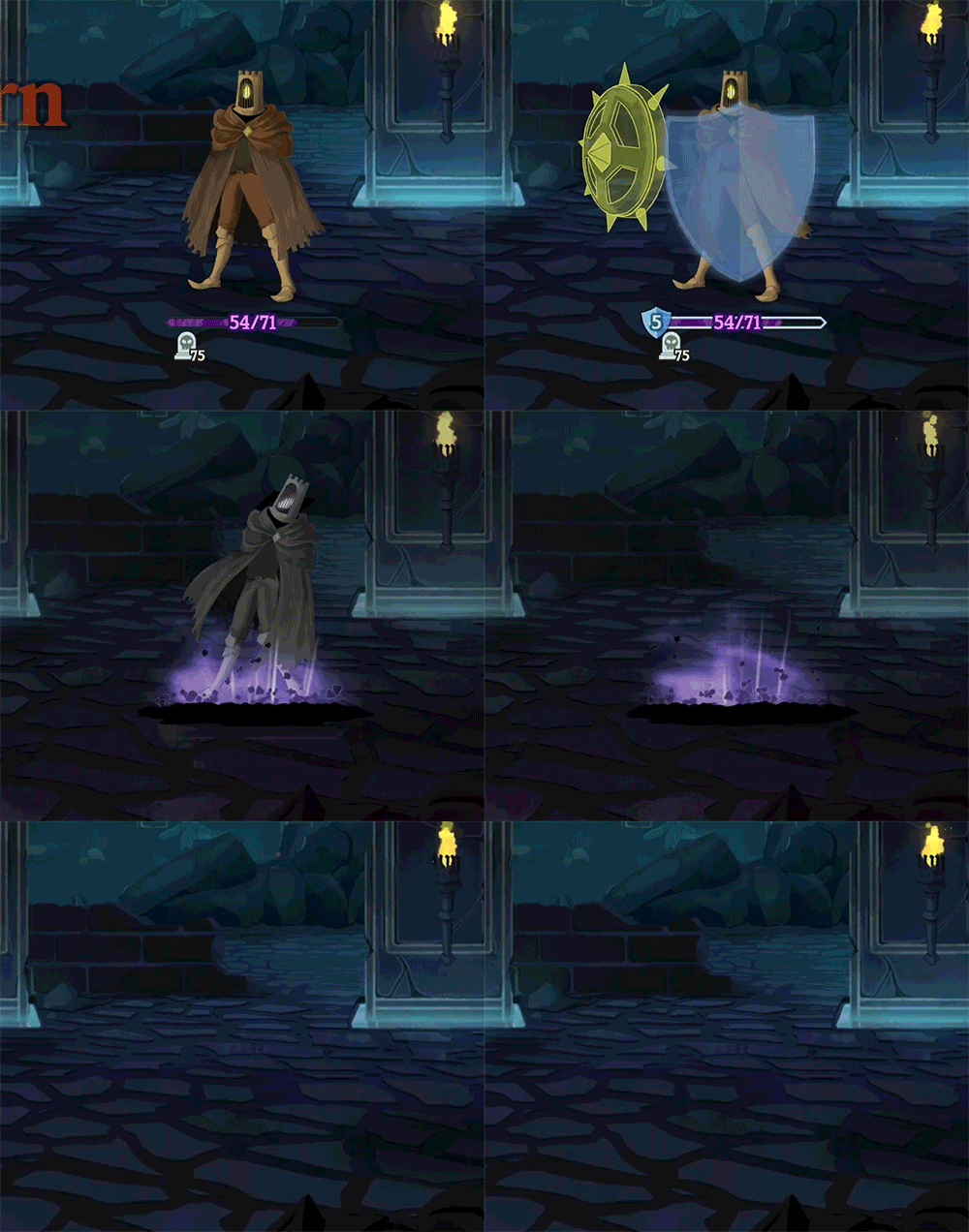
Doom defeating a knight enemy in Slay the Spire 2
The Doom reveal makes the mechanic legible immediately, which helps players understand the threshold kill rule at a glance.

Doom is Necrobinder's class-defining keyword. It is applied the same way Poison is applied, but Doom does not tick down and does not deal damage while it sits on the target. The payoff is a binary check at end of turn: if Doom ≥ current HP, the enemy dies.

Because the check fires during the target's end-of-turn phase, Doom ignores Block entirely, ignores Metallicize, and ignores whatever buffer state the enemy built up that turn. Against slow-ramping bosses this is the cleanest way to end fights that would otherwise win by attrition.

Verification note

Rules confirmed from the Necrobinder card list on NamuWiki and cross-checked against AsrielMao's Necrobinder primer on Gamersky (2109642). Exponential scaling numbers are taken directly from live card text in the April beta build.

Why Doom matters

If you are seeing Doom for the first time, start with the rule. That is the fastest way to make sense of the fights, cards, and choices built around it.

Once the basic rule clicks, the related links show you where Doom starts changing real decisions in a run.

Learn the rule before you worry about ranking or build theory.

Open the related guides if Doom changes pathing, card picks, or early-act risk.

Come back after major updates if wording, balance, or examples change.

Execution rules and what Doom skips

Doom is tagged as a skill-category debuff, which is why it is applied through non-attack cards even though it resolves as lethal damage. Applying Doom never rolls the target's "on hit" triggers — it does not wake attack thornbacks, does not charge enrage counters, and does not proc elite reprisals.

The kill happens during the enemy end-of-turn step, meaning the target's Block pool is completely irrelevant because Block only absorbs inbound attack damage. That is why Doom is the only reliable counter to Act 3 enemies who stack hundreds of Block in a single turn.

  • Doom ≥ current HP at enemy end of turn → enemy dies regardless of Block.
  • Applying Doom does not proc "when damaged" or "when attacked" triggers.
  • Doom does not decay between turns and persists through Weak, Frail, and Vulnerable.
  • Low-HP boss phase transitions (Soul Fysh split, Doormaker enrage) fire on HP damage, not on Doom execution — Doom skips the phase cleanly.

Core application cards with live numbers

Necrobinder's common slot runs two dedicated Doom appliers. Blight Strike is a 1-cost attack dealing 8 damage (10 upgraded) and applying Doom equal to the damage it just dealt — the cheapest rate of Doom per Energy in the pool. Borrowed Time is a 0-cost skill that applies 3 Doom to self but refunds 1 Energy, letting you chain multiple Doom applications in the same turn.

The uncommon and rare pool is where scaling lives. No Escape is a 2-cost skill that applies 10 Doom (15 upgraded) and adds 5 bonus Doom for every 10 Doom already on the target. At 40 existing Doom that single card adds 30 (upgraded: 35), which is how Necrobinder decks break through 200-HP elites.

  • Blight Strike — 1 cost, 8 dmg (10+) + Doom equal to damage dealt.
  • No Escape — 2 cost skill, 10 Doom (15+) + 5 per 10 existing Doom. Exponential curve.
  • Deathbringer — 2 cost skill, 21 Doom AoE (26+) plus 1 Weak to every enemy.
  • End of Days — rare 2 cost skill, 29 Doom AoE (37+) then executes every target with HP ≤ current Doom.
  • Time's Up — rare 1 cost attack, damage equal to target's current Doom, Exhaust (Retain on upgrade).

Self-Doom engines and the Energy trade

Several of Necrobinder's best economy cards apply Doom to the player as a cost. Borrowed Time (3 Doom to self for +1 Energy), Oblivion (3 Doom per card played this turn for 4 upgraded), and Neurosurge (rare power, every turn: +1 Energy, draw 2, 3 Doom to self) all trade player HP runway for tempo.

This is safe because the Doom stacks on the player are only lethal if player HP hits that number at end of turn. As long as Necrobinder keeps HP above the accumulated self-Doom total, the mechanic functions as deferred fuel — not damage.

  • Borrowed Time — 0 cost skill, +1 Energy, 3 Doom to self.
  • Oblivion — rare skill, 3 Doom (4+) to self per card played this turn.
  • Neurosurge — rare power, each turn: +1 Energy, draw 2, 3 Doom to self.
  • Calcify — power, Osty attacks gain +4 damage (+6 upgraded), covers Osty HP while you stack self-Doom.

Doom scaling powers and turn-start generators

Powers that apply Doom passively are what separate Doom decks from mere Doom touches. Countdown is a power that applies 6 Doom (9 upgraded) to a random enemy at the start of every turn — over a 4-turn fight that is 24 to 36 Doom on top of your card play.

Shroud is the defensive counterpart: a power that grants 2 Block (3 upgraded) per point of Doom you applied that turn. Stacking Shroud plus Blight Strike lets Necrobinder tank multi-hit bosses while building the lethal threshold.

  • Countdown — power, 6 Doom (9+) to a random enemy at start of turn.
  • Shroud — power, 2 Block (3+) per Doom applied this turn.
  • Reaper Form — rare power, apply Doom equal to damage dealt by your attacks.
  • Death's Door — uncommon skill, 6 Block (7+), duplicated once if you applied Doom this turn — 14 Block peak.

Doom deck shell and boss routing

A functional Doom shell picks up Countdown or Reaper Form as the scaling engine, pairs it with No Escape for the breakpoint hit, and keeps Deathbringer for multi-enemy turns. The defensive floor is Shroud plus Death's Door — both cards scale off the same Doom plays, so you never sacrifice offense for block.

For Act 2, Doom cleanly answers Knowledge Demon because it ignores the Demon's reactive Barricade-style block. For Act 3, Doom is the single best tool against Doormaker's wall-of-block pattern — you do not need to punch through the Block, you just need the threshold to fire.

  • Priority picks: No Escape > Countdown > Reaper Form > End of Days > Blight Strike.
  • Keep Time's Up Retained — one upgraded copy ends most elite fights when Doom clears 60.
  • Don't cut all attacks — Doom needs an HP damage plan to shorten the runway from Max HP down to threshold range.
  • Osty's damage is independent of Doom — use Calcify to cover HP pressure while self-Doom engines run.

Mistakes that sink Doom runs

The most common trap is treating Doom as pure ramp. Doom decks that skip every attack card end up stacking 120 Doom on a Soul Fysh at 220 HP and dying before the threshold meets. Doom needs an HP pressure component — even a single upgraded Cleave or a Shiv splash pays for itself.

The second trap is forgetting Doom executes at end of the enemy's turn. If the enemy telegraphs a lethal attack this turn, Doom does not save you unless the threshold was already met before the attack resolves. Plan block for the incoming turn, then let Doom resolve.

  • Don't skip all attacks. Doom needs HP damage to shorten the kill window.
  • Remember the timing — Doom fires on the enemy's end of turn, after their attack resolves.
  • Don't overstack self-Doom past your max HP unless you have a heal line.
  • Upgrade No Escape early — 15 base Doom compounds faster than any other priority.

Comparison

How this differs from Slay the Spire 1

Doom is not a lightly renamed old keyword. It introduces a threshold-kill identity that the launch roster of the first game did not have.

FAQ

Does Doom deal any damage on its own?

No. Doom sits on the target with zero effect until the target ends its turn with Doom ≥ current HP, at which point it dies outright. Doom is applied the same way Poison is applied, but the similarity ends there — it does not tick, does not decay, and does not chip.

Can Block or Metallicize save an enemy from Doom?

No. Block absorbs inbound attack damage, and Doom's execution is not routed through attack damage — it checks HP at end of turn. Metallicize, Intangible, and Buffer behave the same way. Doom is the only clean counter to Act 3 wall-of-block enemies.

Is the No Escape scaling really exponential?

Yes. Base No Escape is 10 Doom (15 upgraded) plus 5 extra per 10 Doom already on the target. At 0 stacks it applies 10; at 40 stacks it applies 30 (upgraded 35). Chaining two No Escapes in one turn is the fastest way to cross 100 Doom on a boss.

Does applying Doom trigger on-hit reactions?

No. Doom is a skill-category debuff. Blight Strike still rolls on-hit because it also deals attack damage, but skill-based Doom cards (No Escape, Deathbringer, Countdown, End of Days) never wake attack-react enemies or charge enrage counters.

Why stack self-Doom with Borrowed Time and Neurosurge?

Self-Doom kills the player only if player HP ≤ self-Doom at end of turn. As long as your HP pool stays above the accumulated self-Doom total, Necrobinder keeps Energy, draw, and tempo the same way Silent's self-damage engines trade HP for setup.

How does Doom interact with boss phase transitions?

Soul Fysh, Doormaker, and other HP-triggered transitions fire when the boss takes HP damage below the threshold. Doom's execution is not HP damage — it removes the target wholesale. The phase transition is skipped, which is why Doom decks trivialize fights built around reactive phase mechanics.

What's the fastest Doom lethal window on A20 Watcher equivalents?

On a 220-HP Act 2 elite, a three-card turn of Blight Strike+ → No Escape+ → No Escape+ with one Countdown stack already running lands roughly 10 + (15+5×1) + (15+5×3) = 60 Doom in one turn on top of the prior ramp, closing the kill on turn 3 or 4.