Can I remove an Enchantment later?
No. Enchantments are permanent and irreversible for the entire run. This is confirmed by Mega Crit's official Neowsletter and verified in early-access play.
Enchantments are permanent, irreversible card modifiers. This guide covers every confirmed Enchantment type, the selection principles that top players agree on, and build examples that use Enchantments as a win condition.
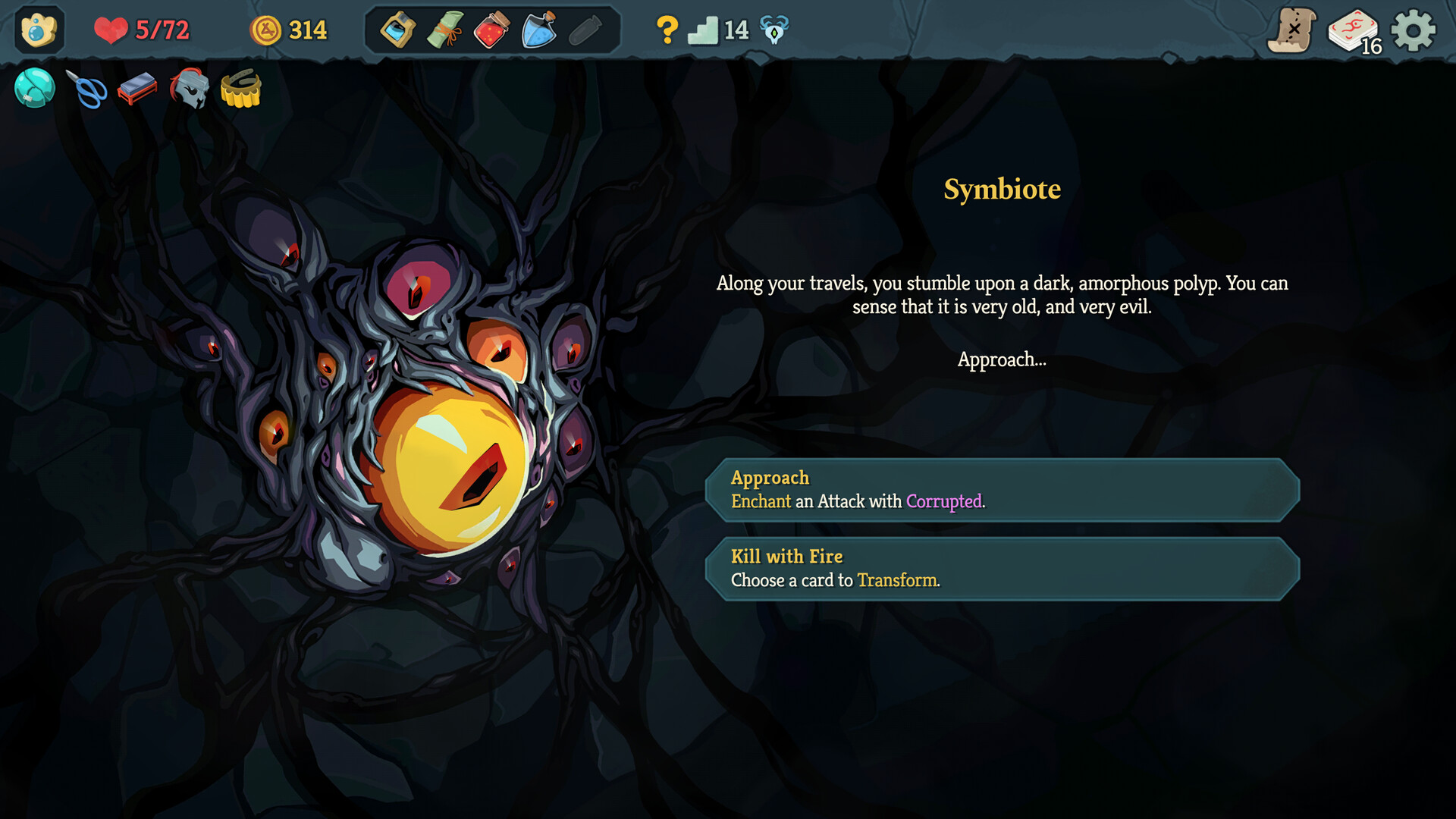
Enchantments are one of the most misunderstood systems in Slay the Spire 2. New players treat them as free upgrades. Experienced players know they are double-edged bets that can carry a run or quietly destroy it.
Every Enchantment modifies a card for the rest of the run. That permanence is the entire point: a good Enchantment on the right card at the right time is transformative, but a bad Enchantment on the wrong card is a permanent tax you pay every combat.
Verification note
Cross-referenced from Mega Crit's official Neowsletter #7, Deltia's Gaming, Mobalytics, 17173.com, and GamerSky launch-week guides. Specific numbers verified against multiple independent sources.
Fast takeaway
This guide is built around one practical question, so you can use it during a run instead of digging through a broad overview.
If the answer depends on a mechanic, a character system, or a recent patch, the related links show you what to open next.
Use this when you want a direct answer instead of a broad overview.
Follow the related links if this decision depends on a mechanic, character system, or co-op rule.
Check the update pages whenever balance changes might shift the recommendation.
Corrupted Enchantment adds 50% attack damage but costs 3 HP every time you play the card. It is strongest on high-damage finishers you play once or twice per combat (, ) and weakest on high-frequency cards like Shivs where the HP drain compounds fast.
Spirit Enchantment turns an Exhaust card into a Strength generator. The Chinese community calls this the most explosive Ironclad build in early access: a 0-cost card with Spirit Enchantment gains +2 Strength per play, and + + let you cycle it every turn for free.
Vulnerability Enchantment adds Vulnerable application to an attack at the cost of increased energy. It is best on opening-turn attacks in Strength builds because Vulnerable multiplies all subsequent hits in the same combat.
These principles are consistent across English, Chinese, and Japanese community guides. They hold regardless of which specific Enchantment you are evaluating.
This is the highest-profile Enchantment build in the Chinese community. The core is a 0-cost Exhaust card with Spirit Enchantment that generates +2 Strength every time it is played. makes all Skills cost 0 energy but Exhaust after use. draws a card whenever you Exhaust. gives Block whenever you Exhaust.
The result is a free Strength engine: every turn, cycle through your Skills at 0 cost, gain Strength, draw cards, and gain Block. Finish with (Block → damage) or (0 cost, 17 AoE damage).
The build requires three specific cards (, , ) plus the Spirit Enchantment. That makes it a high-ceiling, medium-consistency strategy: devastating when assembled, but dependent on finding the right pieces.
The simpler Enchantment build: put Corrupted on your primary finisher ( or a multi-hit attack) and scale Strength with plus current-card-pool support like and . At 20+ Strength, the 3 HP cost per play is irrelevant because the fight ends in one or two swings.
The key rule is to Enchant only your finisher card, never your cycling or support cards. A Corrupted costs 3 HP every time you draw through your deck, which adds up across a long run.
FAQ
No. Enchantments are permanent and irreversible for the entire run. This is confirmed by Mega Crit's official Neowsletter and verified in early-access play.
No. Enchantments are trade-offs. A bad Enchantment on the wrong card is a permanent downgrade. Skip the event if your build direction is unclear or if the offered Enchantment does not match your deck.
Vulnerability Enchantment on a turn-1 attack is the safest choice because it amplifies all subsequent damage without a recurring HP cost. Corrupted is high-risk, high-reward. Spirit requires a specific Exhaust shell to function.
Necrobinder also has Exhaust synergies and can use Spirit Enchantment effectively. Silent and Regent lack the Exhaust infrastructure to make it consistent.
Sources
Mega Crit early access launch post
OfficialOfficial launch article for the current early access build.
Neowsletter: Enchantments
OfficialOfficial explanation that Enchantments are run-long card modifiers.
Neowsletter: January 2026
OfficialOfficial reminder that many systems and values were still evolving right before early access.
Deltia's Gaming: Enchantments and Ancients explained
AuthorityDetailed explanation of both the Enchantment and Ancient systems in STS2.