Back to Tips
Meta AnalysisVerified March 31, 2026

Slay the Spire 2 Character Tier List: Best Characters Ranked for High Ascension

A data-driven character tier list for Slay the Spire 2 (v0.101.0+) ranking all 5 characters for high Ascension solo play, co-op, and beginner accessibility. Ironclad and Necrobinder sit at S-tier, Silent and Defect at A-tier, and Regent rises to A-tier after v0.101.0 buffs. Includes per-character strengths, weaknesses, best archetypes, and meta shift analysis.

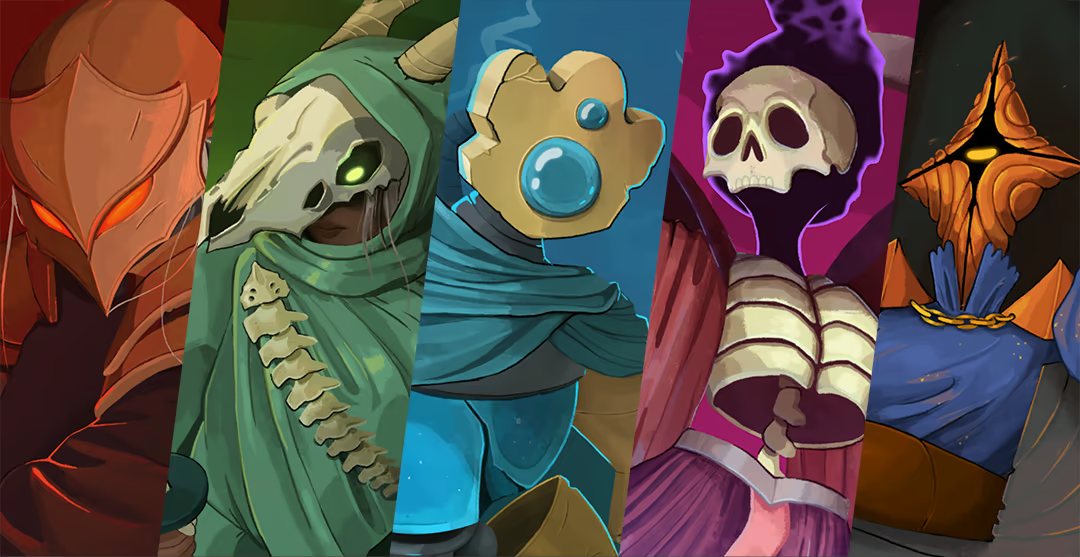
The five playable characters in Slay the Spire 2 ranked by Ascension viability
All five launch characters can clear the game, but their consistency at Ascension 10+ varies significantly.

Slay the Spire 2 launched Early Access with five playable characters: three returning veterans (Ironclad, Silent, Defect) and two newcomers (Necrobinder, Regent). Each character has distinct mechanics, card pools exceeding 80 cards, and multiple viable archetypes. But they are not equal in power.

This tier list ranks every character based on high Ascension solo win consistency, co-op contribution, archetype flexibility, and accessibility for new players. Tier placements reflect the post-v0.101.0 meta, which buffed Regent significantly and restored key Silent cards (Prepared, Borrowed Time) that were removed in v0.100.0.

The rankings draw on kamigame.jp's character evaluations, NamuWiki's per-character meta breakdowns, Gamersky community consensus, and Ascension 20 win-rate discussions across Reddit and Steam forums. No character is unplayable — even the lowest-ranked character clears Ascension 20 in experienced hands. The difference is consistency and margin for error.

Verification note

Cross-referenced kamigame.jp character ratings (S-tier Ironclad/Necrobinder, A-tier Silent/Defect/Regent), NamuWiki per-character meta analysis, Gamersky community power rankings, Reddit Ascension 20 win-rate discussions, v0.101.0 patch notes (Regent buffs: Falling Star/Parry improvements), and stratgg.com card database for archetype depth counts. Tier placements reflect post-v0.101.0 meta.

Fast takeaway

This guide is built around one practical question, so you can use it during a run instead of digging through a broad overview.

If the answer depends on a mechanic, a character system, or a recent patch, the related links show you what to open next.

Use this when you want a direct answer instead of a broad overview.

Follow the related links if this decision depends on a mechanic, character system, or co-op rule.

Check the update pages whenever balance changes might shift the recommendation.

Tier List Overview

The tier list uses four criteria: (1) high Ascension solo win rate, (2) co-op team contribution, (3) number of viable archetypes, and (4) beginner accessibility. Characters with more viable paths through any given run rank higher because flexibility reduces the impact of bad RNG.

  • S-Tier: Ironclad, Necrobinder — Highest win consistency at Ascension 15+. Multiple strong archetypes. Forgiving mechanics that tolerate imperfect play. Both have self-sustain (Burning Blood, Soul cycling) that reduces run-ending variance.
  • A-Tier: Silent, Defect, Regent — Strong characters with clear win conditions. Slightly more dependent on specific card finds or build commitments. Silent and Defect carry over proven STS1 frameworks. Regent rose from B-tier to A-tier after v0.101.0 buffs to Falling Star and Parry.
  • No B/C-Tier characters exist in the current meta. All five characters can clear Ascension 20. The gap between S and A tier is consistency, not capability.

S-Tier: Ironclad — The Consistent Powerhouse

Kamigame.jp rates Ironclad S-tier with a 5/5 Strike axis score. He is the most consistent character in STS2 thanks to four distinct archetypes (Strength, Exhaust, Barricade Block, Self-Damage/Rupture), the highest starting HP (80), and Burning Blood's post-combat healing that enables aggressive elite farming from floor 1.

The Ironclad rarely has a dead run. If Strength sources appear, take them. If Corruption shows up, pivot to Exhaust. If Barricade arrives early, go Block. If Rupture appears, build Self-Damage. This four-way flexibility means the Ironclad can adapt to almost any card offering sequence.

  • Strengths — Four viable archetypes (most of any character). 80 starting HP is the highest. Burning Blood enables aggressive pathing. Bash provides Vulnerability from the starting deck. Limit Break + Heavy Blade scaling has no damage ceiling. Dropkick infinite loop is still functional post-v0.100.0.
  • Weaknesses — Draw power is limited compared to Silent or Necrobinder. No innate cycling mechanic. Strength builds need 2-3 acts to reach full power. Dead Branch removal weakened Exhaust builds compared to STS1.
  • Best Archetypes — Strength Scaling (highest consistency): Inflame, Limit Break, Pummel Strike. Exhaust Engine: Corruption, Feel No Pain, Dark Embrace. Barricade Block: Barricade, Body Slam, Entrench. Self-Damage (new in STS2): Rupture, Combust, Hemokinesis.
  • Why S-Tier — No bad matchups against any boss. Vulnerability from Bash is universally useful. Four archetypes mean you almost always find a viable path. Burning Blood reduces the cost of mistakes. The Ironclad is the only character that can win with a mediocre deck because Strength scaling carries suboptimal card pools.

S-Tier: Necrobinder — The Execution Machine

Kamigame.jp rates Necrobinder S-tier. The Necrobinder is the strongest damage dealer in STS2 thanks to the Doom mechanic, which executes enemies below a damage threshold instead of requiring full HP reduction. This bypasses traditional scaling requirements and makes the Necrobinder the fastest boss killer in the game.

The Necrobinder's Souls mechanic (0-cost draw tokens) provides exceptional card cycling, solving the draw problems that plague other characters. Combined with Exhaust synergies and the companion Osty, the Necrobinder has the deepest toolkit of any character in STS2.

  • Strengths — Doom bypasses HP totals (execute enemies below threshold). Souls provide free draws, solving hand quality issues. Three strong archetypes: Exhaust, Doom scaling, Minion/Osty. Osty (companion) absorbs damage and deals passive damage. Exhaust synergies thin the deck aggressively. Strongest boss-killing potential of any character.
  • Weaknesses — Doom requires setup turns before it becomes lethal. Early Act 1 can be rough without immediate Doom payoffs. More complex to pilot than Ironclad — sequencing Souls and Exhaust correctly requires practice. Weaker against enemies with high HP thresholds until Doom stacks.
  • Best Archetypes — Doom Scaling (highest ceiling): No Escape (exponential Doom), Dark Pact (exhaust cycling). Exhaust Engine: mirrors Ironclad exhaust but with Souls for draw. Minion Build: Osty + support cards for a two-pronged attack.
  • Why S-Tier — Doom is the most powerful single mechanic in STS2. It turns boss fights from endurance tests into execution puzzles. Souls solve the universal problem of bad draws. The Necrobinder has the highest ceiling of any character and a floor that still clears content consistently. Kamigame and NamuWiki both rate the Necrobinder at or above Ironclad for experienced players.

A-Tier: Silent — The Proven Framework

Kamigame.jp rates Silent A-tier. The Silent carries over two proven archetypes from STS1 — Poison and Shivs — and gains a powerful new Sly keyword in STS2. v0.101.0 restored Prepared and Borrowed Time, which were removed in v0.100.0, significantly improving the Silent's consistency.

The Silent's Sly discard archetype has the highest single-turn damage ceiling of any character in STS2. Discarded Sly cards play themselves for free, creating explosive turns where 5+ cards resolve in a single action. However, this ceiling requires specific card combinations, making it less consistent than Ironclad's Strength or Necrobinder's Doom.

  • Strengths — Poison bypasses Block entirely (damage over time). Sly discard has the highest single-turn damage ceiling in the game. Shivs provide consistent chip damage and proc relic effects. Three distinct archetypes cover different strategies. v0.101.0 restored Prepared and Borrowed Time, improving consistency. Strong draw engine through Backflip, Acrobatics, and cycling.
  • Weaknesses — Poison is slow against bosses with high HP scaling phases. Shivs fall off in Act 3 without scaling support. Sly builds require specific card combinations to reach their ceiling. No innate self-healing (unlike Ironclad's Burning Blood or Necrobinder's Osty). More dependent on good early card offers than S-tier characters.
  • Best Archetypes — Poison: Deadly Poison, Catalyst (triple poison), Noxious Fumes (passive stacking). Sly/Discard: Sly-keyword cards auto-play when discarded, Calculated Gamble, Tactician. Shivs: Blade Dance, Cloak and Dagger, Accuracy (+damage per Shiv).
  • Why A-Tier (Not S) — Two of three archetypes (Poison, Shivs) have known scaling ceilings against late-game bosses. Sly has no ceiling but requires lucky card finds. The Silent wins most runs but occasionally faces dead runs where no archetype comes together. The v0.101.0 Prepared/Borrowed Time restorations partially addressed this inconsistency.

A-Tier: Defect — The Rebuilt Engine

Kamigame.jp rates Defect A-tier. The Defect underwent the largest mechanical overhaul from STS1 to STS2. Permanent Focus stacking was removed, fundamentally changing how Orb builds scale. Dark Orbs now scale with time rather than Focus. Plasma Orbs solve energy problems. The Claw archetype returned with full support (Scrape, All for One, FTL, Beam Cell).

The Defect in STS2 is a different character than in STS1. Players who attempt to recreate STS1 Focus-stacking strategies will struggle. The Defect rewards players who understand the new Orb economy: passive damage from Dark Orbs over time, Plasma for energy, and Lightning for consistent chip damage.

  • Strengths — Orbs provide passive damage and utility every turn without card plays. Plasma Orbs solve energy problems, enabling expensive card plays. Claw archetype provides a reliable low-cost scaling path. Dark Orbs scale automatically over time, rewarding long fights. Strong AoE through Lightning Orbs. Cracked Core (starter relic) provides free Orb generation from turn 1.
  • Weaknesses — Permanent Focus stacking is gone — cannot recreate STS1's infinite Focus builds. Dark Orb scaling is slow in short fights (Act 1 elites). Orb slots are limited, requiring management decisions. More dependent on understanding the new Orb economy than any other character's learning curve. Frost Orbs alone cannot sustain defense against high-damage bosses.
  • Best Archetypes — Dark Orb Control: let Dark Orbs accumulate damage passively, channel new Orbs strategically. Claw Deck: Claw, Scrape, All for One, FTL, Beam Cell (0-cost scaling). Plasma Energy: use Plasma Orbs to fund expensive Powers and attacks.
  • Why A-Tier (Not S) — The reworked Orb system has a learning curve that punishes players carrying STS1 habits. Dark Orbs are slow starters. The Defect has fewer viable archetypes (3) than Ironclad (4) and less raw power than Necrobinder's Doom. But once mastered, the Defect's passive Orb damage provides a unique advantage in long fights where other characters need to spend cards to deal damage.

A-Tier: Regent — The Rising Star (Post-v0.101.0)

Kamigame.jp rates Regent A-tier. The Regent is the most mechanically unique character in STS2, using two persistent currencies — Stars (resource) and Forge (crafting) — instead of traditional deckbuilding synergies. Before v0.101.0, the Regent was widely considered the weakest character due to slow Star accumulation and split build paths that diluted each other.

v0.101.0 changed the Regent's trajectory. Buffs to Falling Star and Parry directly addressed the core complaints: Star generation was too slow and defensive options were too thin. Post-patch, the Regent is a legitimate A-tier character with two strong archetypes and explosive burst potential through Seven Stars (7 Stars = 49 AoE damage).

  • Strengths — Stars persist between turns, creating a resource management layer unique to the Regent. Seven Stars converts accumulated Stars into 49 AoE damage (7 Stars x 7 damage). Sovereign Blade (Retained weapon) provides consistent damage every turn. Forge archetype creates permanent upgrades mid-combat. v0.101.0 Falling Star buff improved Star generation. v0.101.0 Parry buff improved defensive consistency.
  • Weaknesses — Stars and Forge dilute each other if pursued simultaneously — pick one. Star accumulation is still slower than Necrobinder's Doom or Ironclad's Strength. Sovereign Blade dependency can become a liability against enemies that strip Retained cards. Smallest community knowledge base (newest character, least explored). No community-proven infinite combos.
  • Best Archetypes — Stars Burst: Big Bang (0-cost cycle), Alignment (Stars to Energy), Seven Stars (finisher). Focus Stars exclusively — do not mix with Forge. Forge Crafting: permanent mid-combat upgrades. Slower but more consistent than Stars. Sovereign Blade Midrange: use Retained Sovereign Blade as a reliable damage source, supplement with Stars or Forge.
  • Why A-Tier (Not S) — The Regent was B-tier before v0.101.0. The Falling Star and Parry buffs elevated the character significantly, but the Regent still has the smallest proven archetype pool and the steepest learning curve. Community knowledge is months behind the other four characters. The Regent's ceiling may be S-tier once more tech is discovered, but current data places the character solidly at A.

v0.101.0 Meta Shift Analysis

Patch v0.101.0 reshuffled the meta in three significant ways: Regent buffs, Silent card restorations, and the Doormaker boss rework. Understanding these changes is essential for accurate tier placement.

  • Regent Buffs — Falling Star now generates Stars more efficiently, addressing the core complaint that Star accumulation was too slow. Parry improvements give the Regent a real defensive option instead of relying entirely on Stars for both offense and defense. These two changes alone moved the Regent from B-tier to A-tier in community consensus.
  • Silent Restorations — Prepared and Borrowed Time were removed in v0.100.0 and restored in v0.101.0. These cards are essential for the Sly/discard archetype. Their return improved the Silent's consistency and prevented the character from dropping to B-tier.
  • Doormaker Rework — The Doormaker boss was changed from random mechanics to a 3-form phase rotation (damage/debuff/defense). This change benefits patient characters (Ironclad Strength stacking, Regent Star accumulation) and slightly hurts aggressive characters that preferred to race the old random Doormaker.
  • Infinite Combo Return — v0.101.0 eased some of the anti-infinite measures from v0.100.0. The Dropkick Loop (Ironclad) is functional again. No confirmed infinite loops exist for Regent, but community research is ongoing.
  • Map Generation Fix — Elites no longer appear on floor 6, and early monster density was reduced. This benefits all characters equally but disproportionately helps weaker Act 1 characters (Regent, Defect) who previously faced punishing early elites before their builds came online.

Solo vs Co-op Tier Differences

Co-op (2-4 players) changes the meta significantly because boss HP scales (1.75x/2.5x/3.25x for 2/3/4 players) but enemy damage does not change. This shifts value toward support, debuffs, and sustained damage over burst.

  • Necrobinder: S-tier in Solo, S+-tier in Co-op — Doom scales independently of boss HP (execute threshold is percentage-based). Osty provides team utility. Souls draw benefits from longer fights. The Necrobinder is the single strongest co-op character.
  • Ironclad: S-tier in Solo, A+-tier in Co-op — Bash's Vulnerability benefits all teammates' damage. Strength scaling is less impactful when boss HP is 2-3x higher and other players handle damage. The Ironclad shifts to a support/debuff role in larger groups.
  • Silent: A-tier in Solo, A-tier in Co-op — Poison damage ignores Block, which scales well in co-op. Shivs trigger on-attack relics for teammates. Sly remains a solo-oriented archetype. Consistent but not dominant in either mode.
  • Defect: A-tier in Solo, A-tier in Co-op — Orbs provide passive damage without consuming team actions. Lightning AoE clears adds. Frost Orbs can absorb damage for the team. Utility-focused but lacks the raw power to carry co-op fights.
  • Regent: A-tier in Solo, B+-tier in Co-op — Stars are self-contained and do not benefit teammates. Sovereign Blade damage does not scale with team size. The Regent contributes the least to team synergies. In co-op, the Regent is the weakest pick unless the Stars build is fully online.

Beginner Recommendations

For players new to Slay the Spire 2 (or to the series entirely), character choice significantly impacts the learning experience. The goal is to learn core game mechanics — deckbuilding, pathing, event choices, boss preparation — without the character's mechanics adding unnecessary complexity.

  • First Character: Ironclad — Highest HP (80), post-combat healing, and intuitive Strength scaling. Bash teaches Vulnerability. Limit Break teaches multiplicative scaling. Burning Blood forgives mistakes. kamigame.jp recommends Ironclad for first victories.
  • Second Character: Silent — Poison teaches damage-over-time strategy. Shivs teach multi-hit scaling. Backflip and Acrobatics teach draw management. Two well-documented archetypes from STS1 with extensive community guides.
  • Third Character: Necrobinder — Doom teaches execution thresholds. Souls teach resource management. Exhaust teaches deck thinning. More complex than Ironclad/Silent but extremely rewarding once understood.
  • Fourth Character: Defect — Orb management requires understanding a resource system unique to STS2. Players coming from STS1 must unlearn Focus stacking. Best approached after understanding the base game through other characters.
  • Fifth Character: Regent — Most mechanically unique. Stars and Forge have no parallel in STS1 or other STS2 characters. Smallest community knowledge base. Play last to bring maximum game understanding to the steepest learning curve.

FAQ

Which character has the highest win rate at Ascension 20?

Community data points to Necrobinder and Ironclad as the highest. Necrobinder's Doom mechanic bypasses traditional damage requirements, making boss fights faster. Ironclad's four archetypes provide the most flexibility to adapt to any run's card offerings. Both characters have self-sustain that reduces variance. Exact win rates are not officially tracked, but Reddit polls and community discussions consistently place these two at the top.

Is Regent the worst character?

Not anymore. Before v0.101.0, community consensus placed Regent at B-tier due to slow Star generation and thin defensive options. The v0.101.0 buffs to Falling Star and Parry directly addressed these issues. Post-patch, Regent is A-tier in solo play. In co-op, Regent is the weakest pick (B+-tier) because Stars do not benefit teammates. The character's ceiling may be higher than current rankings suggest — community optimization is still ongoing.

What changed in v0.101.0 that affected the tier list?

Three major changes: (1) Regent received buffs to Falling Star and Parry, moving the character from B-tier to A-tier. (2) Silent recovered Prepared and Borrowed Time, which were removed in v0.100.0, stabilizing the Sly/discard archetype. (3) The Doormaker boss was reworked from random mechanics to a phase rotation, benefiting patient builds. Additionally, elites no longer spawn on floor 6, helping weaker Act 1 characters survive early.

Which character is best for co-op?

Necrobinder. Doom's execution threshold is percentage-based, so it scales independently of boss HP multipliers (1.75x/2.5x/3.25x for 2/3/4 players). Osty provides team utility by absorbing hits. Souls draw gives longer fights more value. The Necrobinder is the only character that gets stronger in co-op relative to solo play.

Should I play Ironclad or Necrobinder first?

Ironclad. The Ironclad is simpler to pilot and teaches STS2's core mechanics (Strength, Vulnerability, Exhaust, Block) with a forgiving HP pool. The Necrobinder is stronger at the ceiling but requires understanding Doom thresholds, Soul management, and Exhaust sequencing — concepts that are easier to learn after the Ironclad teaches the basics.

Will Watcher be added to STS2?

The Watcher is expected during Early Access but is not in the game at launch. The Watcher's Stance mechanic from STS1 would significantly change the tier list if carried over. Community speculation places the Watcher release in mid-to-late 2026 based on development pace, but no official date has been confirmed.

How often does the meta change?

Major patches occur roughly every 2-4 weeks during Early Access. v0.100.0 and v0.101.0 each shifted the meta significantly. The tier list reflects the post-v0.101.0 meta. Future patches may change rankings — particularly for Regent, whose optimization is least mature. Check patch notes after each update for balance changes.