Back to Characters
Character GuideVerified March 10, 2026

Silent

Silent is the highest-ceiling character in Slay the Spire 2. The new Sly keyword turns discard into free damage, but the 70 HP pool and zero built-in healing make her the most punishing class for mistakes. Mastering discard order is the core skill.

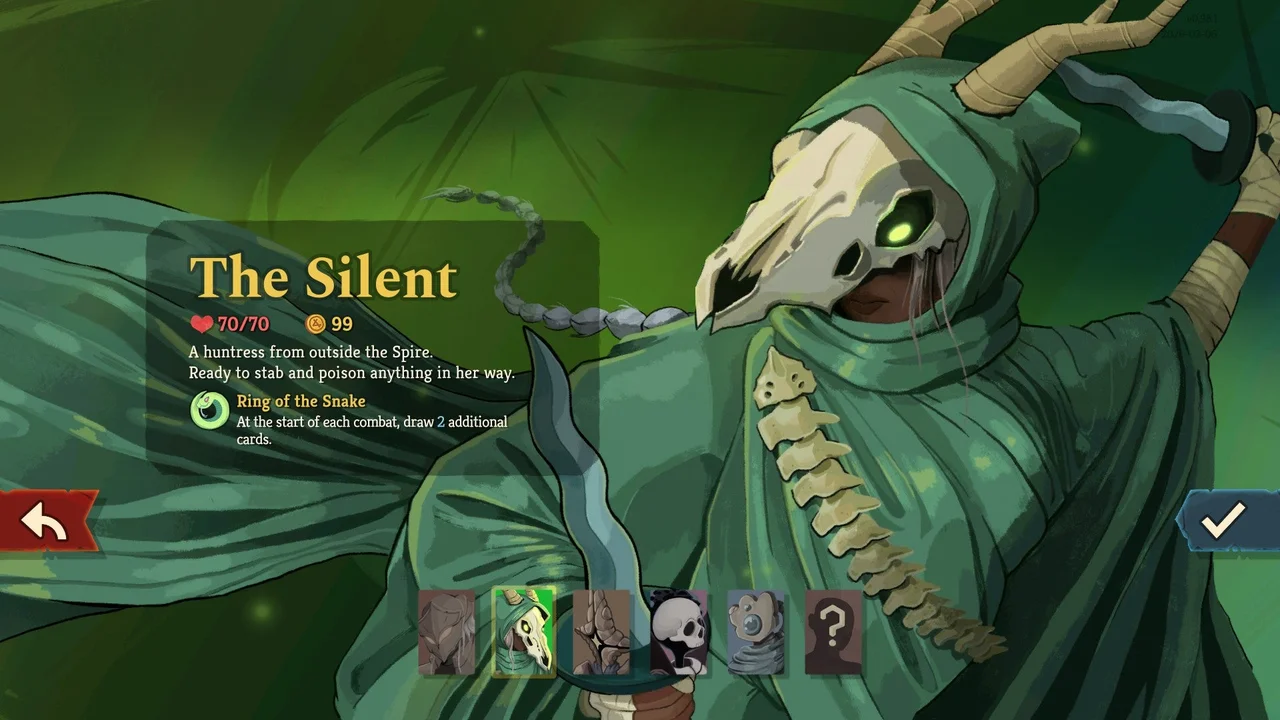
Silent character portrait in Slay the Spire 2
Silent is the highest-ceiling character in STS2, built around the new Sly discard mechanic.

Silent is the character you play when you want the highest possible damage ceiling and are willing to accept the highest possible punishment for mistakes. At 70 HP with no built-in healing, every bad decision costs more than it would on Ironclad or Defect. But the new Sly keyword gives Silent something no other character has: the ability to turn discarding cards into playing them for free.

The STS2 Silent is a fundamentally different character from the STS1 version. Mega Crit's official reveal says more old cards were removed and more new cards were added for Silent than for any other returning character. Sly did not exist in STS1. The discard archetype went from a niche option to Silent's primary identity, and learning when to discard — not just what to discard — is now the core skill.

Verification note

Cross-verified against Mobalytics, TheGamer, Untapped.gg, NamuWiki, and Chinese/Japanese community guides. 88 cards confirmed.

What to focus on with Silent

This guide is built to answer three things fast: what is confirmed about Silent, what makes the class feel different, and what matters in the first few runs.

Think of it as a first-pass class read before you move into build ideas, mechanic explainers, or deeper matchup talk.

Start here before you jump into build speculation or tier lists.

Open the linked mechanics pages if Silent depends on a signature keyword or resource system.

Treat this as an early access primer, not a final meta verdict.

How Sly works

Sly is a keyword that appears on certain cards. When a card with Sly is discarded from your hand during your turn, it plays automatically for zero energy. The card resolves its full effect — damage, Block, draw — and then goes to the discard pile as normal. This means every discard outlet is also a damage outlet.

There are two ways a card gets Sly. Some cards are printed with the Sly keyword naturally — these always have Sly. Others gain Sly during combat through effects like Master Planner (2 cost, Rare Power: all Skills you play gain permanent Sly for the rest of combat). Once Master Planner is active, every Skill in your hand becomes a free play when discarded. This is what creates the infinite loop potential.

Critical rule: Sly only triggers when discarded during your turn, from your hand. Cards milled from your draw pile to your discard pile (via Scrape or similar) do not trigger Sly. Cards discarded at end of turn (when you have more than your hand limit) do trigger Sly. Understanding this distinction is essential because it determines which discard outlets are real Sly triggers and which are traps.

Discard order matters

The order you discard cards determines what happens. When you play Acrobatics (draw 3, discard 1), you choose which card to discard — if it has Sly, it plays for free and may draw additional cards via Reflex (draw 2 when discarded). Those new cards might also have Sly, creating a chain.

Calculated Gamble (0 cost: discard your entire hand, draw the same number) triggers all Sly cards in hand simultaneously. With Master Planner active and five Sly cards in hand, Calculated Gamble effectively plays five cards for free and draws five new ones. If those five also have Sly, you can chain another Calculated Gamble for another free round. This is how Silent reaches tens of thousands of damage per turn.

The beginner mistake is treating discard as random. Silent punishes sloppy sequencing harder than any other character. Before playing a discard card, scan your hand: which cards have Sly, which would you want to play for free, and what might you draw into? A single wrong discard can break a chain that would have dealt lethal damage.

Starting relic and Act 1 decisions

Ring of the Snake draws 2 extra cards on your first turn only (7 cards instead of 5). This is strong because it lets Silent find and play a Power or setup card on turn 1 without sacrificing defense. The optimal turn-1 pattern is: play a Power if you have one, then Block with remaining cards. The extra draw makes this consistently possible.

Silent's Act 1 is harder than Ironclad's because 70 HP with no healing means every hit matters. Prioritize Block cards and Poison application in your first three card rewards. Deadly Poison (1 cost: apply 5 Poison) solves Act 1 hallway fights passively — you apply it once and the enemy dies over 2-3 turns while you Block. Noxious Fumes (1 cost, Power: 2 Poison to all at turn start) is even better because it handles multi-enemy fights.

First campfire: upgrade if you have a card worth upgrading (, , or a key draw card). Rest if you are below 40 HP. Silent has no Burning Blood — every rest stop is a real decision, not an automatic upgrade like Ironclad.

Energy economy and turn sequencing

Silent starts with 3 energy and draws 5 cards per turn (7 on turn 1 via Ring of the Snake). The class feels energy-starved in early fights because many good Silent cards cost 1-2 energy and she lacks free plays until Sly comes online. After Master Planner or enough printed-Sly cards, Silent's effective cards-played-per-turn jumps dramatically — potentially 10-15 cards in a single Calculated Gamble chain.

Turn sequencing is more complex than any other character. A typical mid-game Silent turn: play Powers first, then play draw cards to find your hand, then identify which cards have Sly, then discard in the correct order to chain free plays. Tactician (gain 1 energy when discarded) and Reflex (draw 2 when discarded) both trigger on any discard, not just Sly discard — meaning the same action can generate energy, draw, and free plays simultaneously.

The 0-cost card density matters more on Silent than on other characters. Prepared (0 cost: draw 2, discard 1) and Backflip (1 cost: 5 Block, draw 2) are Silent's draw backbone. A hand with three 0-cost cards and two 1-cost cards plays very differently from five 1-cost cards — the former lets you chain through half your deck, the latter limits you to three plays.

Boss matchups

Silent excels against bosses with high HP pools because Poison scales with time. Knowledge Demon (Act 2) has one of the largest HP pools and a pattern that gives space to stack Poison — this is one of Silent's best matchups. Kaiser Crab's Block phases do not stop Poison damage, making him manageable. The Queen (Act 3) does not reset debuffs between phases, so Poison and Doom both carry through — Silent with a well-timed turn can end The Queen in 2-3 phases.

Silent struggles against Insatiable's instant-death timer because Poison scaling needs turns to accumulate. Against Insatiable, Silent must switch to aggressive Sly chains or Shiv burst rather than relying on passive Poison. Ceremonial Beast (Act 1a) is dangerous at low HP because Silent has no healing — you need to kill it before it kills you.

Kin Priest (Act 1a) heals itself, which counters slow Poison builds. Against Kin Priest, Silent should prioritize faster poison detonation through and rather than gradual stacking. Once Poison is established, an Accelerant turn outpaces the healing window.

Co-op role and team synergy

Silent is the team's damage dealer. In co-op, pair her with a tank (Ironclad) who can absorb hits while Silent builds Poison or Sly chains. The best two-player duo is Ironclad plus Silent: Ironclad applies Vulnerable with Bash while Silent multiplies damage through Poison or Sly free plays. Beacon of Hope (shared Block) helps Silent survive her 70 HP limitation.

In four-player co-op, Silent should focus on single-target boss damage (Accelerant spikes, Sly loops) and leave AoE to Ironclad (Whirlwind) or Regent (Seven Stars). Silent can still help in multi-enemy rooms with Shiv burst and spreading Poison, but she wants teammates covering most of the room-wide cleanup.

Silent pairs poorly with another Silent in co-op because both compete for the damage role and neither provides tanking or utility. The ideal partner is Ironclad (tank/debuff) or Regent (Stars utility/AoE).

Build paths at a glance

Silent has three main archetypes. Sly Discard (S tier) uses Master Planner to turn all Skills into free plays via discard — the highest damage ceiling in the game with infinite loop potential from mid-Act 2. Poison/Accelerant (A+ tier) stacks Poison, then speeds the damage clock with and duplicated skill turns from — the most consistent Silent build and the best for new Silent players. Shiv Spam (A tier) generates 0-cost Shiv tokens and amplifies them with Accuracy and the new Phantom Blades (AoE Shivs) — the fastest Act 1 damage but the lowest ceiling.

For detailed card lists, relic synergies, and combo math for each archetype, see the Silent Builds page.

Common beginner mistakes

Discarding randomly. When a card says 'discard 1,' check what has Sly before choosing. Discarding a non-Sly card when a Sly card was available wastes a free play worth 1-2 energy.

Ignoring Poison because Sly sounds cooler. Poison is more consistent than Sly in Act 1-2 because it requires no specific Rare cards. Build Poison as a baseline and transition to Sly if Master Planner or key discard cards appear. Do not skip Poison sources in Act 1 while waiting for Sly cards that may never come.

Not upgrading Calculated Gamble. The unupgraded version Exhausts on use, limiting it to a single trigger per combat. The upgraded version can be reused every shuffle — the difference between a single burst turn and an infinite loop.

Overvaluing Wraith Form. Wraith Form (3 cost: become Intangible for 2 turns, lose 1 Dexterity permanently each turn after) is powerful but costs 3 energy on a character that needs energy for Sly chains. At high Ascension it is a safety net, not a build-around. New players tend to lean on it instead of learning proper discard sequencing.

Changes from Slay the Spire 1

Sly is entirely new. It changes Silent's core identity from 'Poison character with some discard' to 'discard character with Poison and Shiv options.' This is the biggest mechanical redesign of any returning character. Master Planner, Calculated Gamble (reworked), and all Sly-printed cards did not exist in STS1.

Mega Crit's official reveal says many old Silent cards were removed and more new cards were added than for any returning character. Blade Dance is reworked. Poison fundamentals (, , ) are intact, and the sequel-specific payoff is ticking Poison an extra time per turn. Shiv builds gained AoE via Phantom Blades.

STS2 removed the energy cost on shuffle that existed in STS1. This change is critical for Silent because Sly infinite loops require frequent deck cycling. Without the shuffle penalty, maintaining a loop is dramatically easier once the setup is complete.

Comparison

What changed from Slay the Spire 1

Silent is the returning class with the clearest public redesign. Mega Crit did not present her as a copy-paste nostalgia pick.

Officially confirmedCharacter

What stayed familiar

Slay the Spire 1

Silent rewarded careful hand order, discard judgment, and a generally technical pace.

Slay the Spire 2

Silent still rewards sequencing discipline, but now it does so through a much more explicit discard engine.

Why it matters

The class still suits players who enjoy technical turns, even if the toolkit changed.

Officially confirmedCharacter

Most important difference

Slay the Spire 1

Discard was important, but it was not the same kind of automatic tempo engine the sequel now advertises.

Slay the Spire 2

Sly turns discard into free plays, and Mega Crit directly says Silent's card pool and Blade Dance changed.

Why it matters

This is the biggest official warning that old card memory is not enough to pilot the class well.

Reasonable launch-build readCharacter

How your first runs should change

Slay the Spire 1

You could often feel your way through Silent by trusting old discard and Shiv habits.

Slay the Spire 2

You should treat discard timing as the class's central decision point from the start rather than as a support layer.

Why it matters

Sequencing mistakes cost more when the class can turn discard into free action.

FAQ

Is Silent harder than Ironclad?

Yes. Silent has lower HP (70 vs 80), no built-in healing, and her best builds require precise discard ordering that has no equivalent on Ironclad. Start with Ironclad to learn the game's systems, then move to Silent when you want a higher skill ceiling.

What does Sly actually do step by step?

When you discard a card with Sly from your hand during your turn, that card plays automatically for zero energy. It deals its full damage or Block, then goes to the discard pile normally. It does NOT trigger if the card is milled from draw pile or discarded at end of turn (Retain cards aside).

Should I start with Poison or Sly?

Start with Poison. Deadly Poison and Noxious Fumes are common cards that solve Act 1 reliably. Sly builds depend on finding the Rare card Master Planner. Build Poison as a baseline and pivot to Sly if the right cards appear.

Can Silent solo bosses faster than Ironclad?

At peak performance, yes. Silent's Sly infinite loop produces tens of thousands of damage per turn. But reaching that peak depends on finding specific cards. Ironclad's Strength scaling is more consistent across all runs.