Back to Characters
Character GuideVerified March 10, 2026

Regent

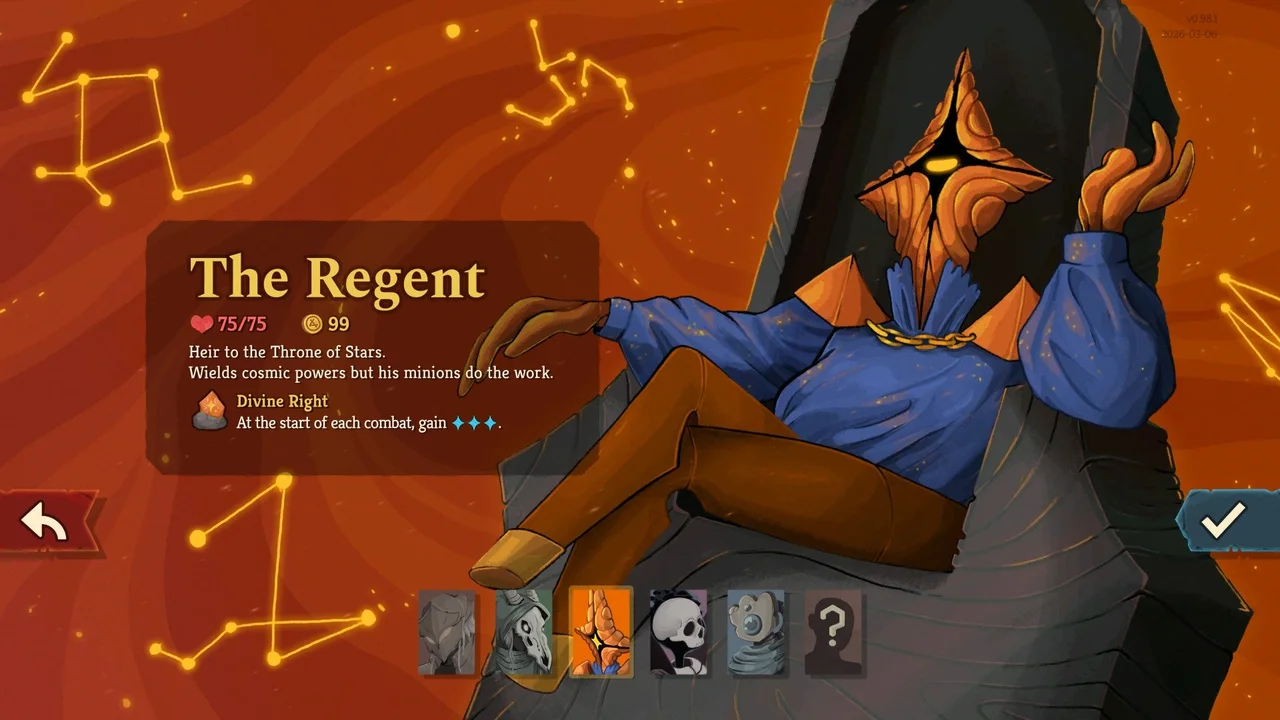
Regent is STS2's resource-management character — built around Stars (a persistent second currency) and Forge (scaling Sovereign Blade). Stars persist across turns with no cap, creating a completely different economy. The critical rule: commit to Stars or Forge, never both.

Regent character portrait in Slay the Spire 2
Regent is STS2's resource-management character, banking Stars across turns for explosive payoff turns.

Regent is the character that feels most unlike any other Slay the Spire class, old or new. Where other characters spend energy and cards each turn, Regent banks Stars — a second currency that persists between turns with no cap. Many Regent cards cost 0 energy but require Stars, and the best cards convert Stars into energy, damage, or both. The result is a character whose turn-by-turn decisions are about when to save and when to spend, not just what to play.

The community consensus is that Star builds are more reliable than Forge builds at high Ascension, and that mixing Stars and Forge dilutes both strategies. Regent is the easiest character to go infinite with (Genesis plus Alignment creates a self-sustaining energy loop), but also has the lowest HP in the roster (68), making Act 1 survival the hardest checkpoint. If you survive to Act 2 with a working Stars engine, Regent is one of the strongest characters in the game.

Verification note

Cross-verified against Mobalytics, NeonLightsMedia, TheGameSlayer, Steam community discussions, Untapped.gg (88 cards confirmed), and Japanese sources (WikiWiki, Togohachi).

What to focus on with Regent

This guide is built to answer three things fast: what is confirmed about Regent, what makes the class feel different, and what matters in the first few runs.

Think of it as a first-pass class read before you move into build ideas, mechanic explainers, or deeper matchup talk.

Start here before you jump into build speculation or tier lists.

Open the linked mechanics pages if Regent depends on a signature keyword or resource system.

Treat this as an early access primer, not a final meta verdict.

How Stars work

Stars are a secondary resource unique to Regent. They are gained and spent by Regent cards but are completely separate from energy. The critical rule: Stars do not empty at end of turn. If you gain 5 Stars on turn 1 and spend 2 on turn 2, you have 3 Stars remaining on turn 3. There is no cap. Some winning runs accumulate 30+ Stars before spending them in one explosive turn.

Cards that cost Stars are written as '0 energy + X Stars' — they cost zero energy but require you to have X Stars when played. Alignment (0 energy, 2 Stars: gain 2 energy) converts Stars into energy. Comet (0 energy, 5 Stars: 33 damage, 3 Weak, 3 Vulnerable) converts Stars into damage and debuffs. Seven Stars (2 energy, 7 Stars: 7 damage to all enemies 7 times) is the primary finisher — 49 total AoE damage before Strength bonuses.

Genesis (2 cost, Rare Power: gain 2 Stars at the start of each turn) is the most important card in Regent's pool. It provides passive Star income that funds the entire build without needing to spend cards or energy on Star generation. A single Genesis means Alignment costs nothing net after 1 turn (gain 2 Stars, spend 2 Stars for 2 energy). Two copies of Genesis make the Stars engine self-sustaining from turn 3 onward.

How Forge works

Forge is a combat-only mechanic that creates and scales Sovereign Blade — a Retained Attack card with 16 base damage. Each point of Forge adds 1 damage to Sovereign Blade. Forge is applied by specific Regent cards: Summon Forth (1 cost: Forge 4, create Sovereign Blade if not created yet), Furnace (1 cost, Power: Forge 4 at start of each turn, upgraded to 6), and Seeking Edge (1 cost: Forge 7, upgraded: Forge 11 plus Blade hits all enemies).

The critical limitation: Forge damage resets each combat. Unlike Necrobinder's Scythe (which permanently scales across the entire run), Sovereign Blade starts at 16 damage every fight and only grows during that fight. This means Forge builds must re-invest in scaling every single combat, which costs energy and cards that could go to defense.

Sovereign Blade costs 2 energy to play. In a 3-energy economy, spending 2 energy on a single Attack plus 1 energy on Forge leaves no room for Block. This is why the community rates Forge lower than Stars — the energy math does not work without exceptional card draws (Decisions, Decisions is almost mandatory). Stars builds solve this because Alignment generates energy from Stars, creating room for both offense and defense.

Why you should not mix Stars and Forge

The community consensus across English, Chinese, and Japanese sources is unanimous: mixing Stars and Forge weakens both strategies. Star cards require a critical mass of Star generation to reach the thresholds for Seven Stars (7 Stars) or Comet (5 Stars). Forge cards require repeated Forge application each combat plus 2 energy per Sovereign Blade play. A deck trying to do both ends up with too few Star generators to fuel Star payoffs AND too little Forge to make Sovereign Blade competitive.

The practical test: by the end of Act 1, your deck should be heading clearly toward one path. If you have Genesis plus Alignment plus Glow, you are a Stars build — skip Forge cards even if they are offered. If you have Furnace plus Seeking Edge, you are a Forge build — skip Star payoff cards. Cards that generate Stars only (like Gather Light: 1 cost, 7 Block, 1 Star) are fine in either build because Stars are also used for defense and utility.

The exception is Big Bang (0 cost: draw 1, gain 1 energy, gain 1 Star, Forge 5, Exhaust), which contributes to both paths. Big Bang is always worth taking because it is net-positive on all resources. It is one of the few cards where the mixing prohibition does not apply.

Starting relic and Act 1 decisions

Crown Jewels gives 3 Stars at combat start. This is less immediately impactful than Burning Blood (healing) or Ring of the Snake (draw) — it provides no survivability and no tempo. The 3 Stars let you play one Stars-cost card on turn 1 (like Alignment for energy conversion or a defensive Star card), but the real value comes in long fights where the persistent currency compounds.

Regent's Act 1 is the hardest in the game because 68 HP is the lowest starting pool and Crown Jewels does not help you survive. Priority commons: Gather Light (1 cost: 7 Block, gain 1 Star) is the best Act 1 card because it provides defense while building Stars. Solar Strike (1 cost: 8 damage, gain 1 Star) does the same for offense. Hidden Cache (1 cost: gain 1 Star now, gain 3 Stars next turn) is the best early setup card.

Do not spend Stars reactively in Act 1. New players panic and spend Stars on defensive cards when threatened, draining the pool before the payoff turn arrives. Regent rewards patience — bank Stars for 2-3 turns, then spend them all in one explosive turn that ends the fight. This feels wrong coming from other characters, but it is the correct Regent playstyle.

Energy economy and turn sequencing

Regent has the most unusual energy economy in the game. Base energy is 3, but Alignment (0 energy, 2 Stars: gain 2 energy) converts Stars into energy, effectively giving Regent 5+ energy per turn once Genesis is online. This changes what 'a good turn' looks like — other characters play 3-4 cards per turn, Regent might play 6-8 cards because half of them cost 0 energy (paid in Stars instead).

Turn sequencing follows a banking pattern. Early turns: play Star generators (Glow, Gather Light, Solar Strike) and bank the Stars. Setup turns: play Genesis, Black Hole, or other Powers. Payoff turns: spend Stars through Alignment for energy, then play Seven Stars, Comet, or Heavenly Drill for massive burst. The rhythm is save-save-save-explode, not play-play-play like Ironclad.

Particle Wall (0 energy, 2 Stars: 9 Block, return to hand) is the repeatable defense card that defines Regent's turn-to-turn survival. It costs Stars, not energy, and returns to hand, meaning you can play it every turn as long as you have Stars. With Genesis providing 2 Stars per turn and Particle Wall costing 2, defense becomes free after setup. This is why Stars builds feel invincible once online — defense and offense both run on the same renewable resource.
Boss matchups

Regent excels against bosses that give time to set up. Doormaker (Act 3) and Ceremonial Beast (Act 1a) both have attack patterns with gaps — these are Regent's best matchups because they let Genesis and Black Hole come online safely. Once the Stars engine is running, Seven Stars (49 AoE damage) and Comet (33 damage plus full debuffs) end fights in 1-2 payoff turns.

Regent struggles against Insatiable (Act 2) because the save-save-save-explode rhythm conflicts with the instant-death timer. Insatiable demands immediate damage output that Regent's banked-resource model does not provide early. Against Insatiable, skip Star banking and play aggressively — Solar Strike and direct damage cards instead of Genesis setup.

The Queen's card binding (3 bound, 1 playable per turn) is devastating for Regent because Stars builds depend on playing many 0-cost cards per turn. With only 1-2 playable cards, the entire Stars economy collapses. Ironclad handles The Queen better because his best cards (, ) are individually powerful on low-card turns. Regent needs to kill The Queen before the bind phase or have enough accumulated Stars to survive on Particle Wall alone.

Co-op role and team synergy

Regent fills the burst-damage and utility role in co-op. Seven Stars (49 AoE damage) is one of the highest AoE damage cards in the game, and Black Hole (3 AoE damage per Star gained or spent) provides passive chip damage during setup turns. In a team, Regent benefits enormously from a tank (Ironclad) who absorbs damage during the 2-3 setup turns before the Stars engine comes online.

The highest-burst two-player duo is Necrobinder plus Regent. Osty absorbs early damage while Regent banks Stars, then both characters explode on the same turn — Doom execution plus Seven Stars creates a one-turn-kill combination. The safest three-player team is Ironclad plus Silent plus Regent: Ironclad tanks, Silent deals consistent Poison damage, and Regent provides burst AoE.

Regent pairs poorly with Defect in co-op because both characters have high setup costs and low early survivability (68 HP and 75 HP respectively). A double-setup team without a tank frequently dies in Act 1.

Build paths at a glance

Regent has two main archetypes plus sub-variants. Star Conversion Engine (S tier) uses Genesis for passive Stars, Alignment for energy conversion, and Seven Stars or Heavenly Drill for burst damage — the easiest infinite in the game and the most reliable high-Ascension path. Forge/Sovereign Blade (B+ tier) scales Sovereign Blade each combat through Forge effects — requires Decisions, Decisions (Rare) to be competitive and suffers from energy constraints. Heavenly Drill Burst (S- tier) is a Stars sub-variant that focuses on the highest single-card damage via Heavenly Drill's non-linear X-cost scaling.

For detailed card lists, relic synergies, and combo math for each archetype, see the Regent Builds page.

Common beginner mistakes

Spending Stars too early. New players spend Stars the turn they get them. Regent rewards patience. Bank Stars for 2-3 turns, then convert them all at once for a massive payoff turn. Early Star spending means you never reach the 7-Star threshold for Seven Stars or the 5-Star threshold for Comet.

Mixing Stars and Forge. This dilutes both strategies. Commit to one path by the end of Act 1. The only exception is Big Bang (contributes to both paths and is always worth taking).

Ignoring Particle Wall. New players skip Particle Wall because '0 energy, 2 Stars for 9 Block' sounds expensive. But it returns to hand every turn, meaning it provides repeatable free defense once Genesis is funding it. Particle Wall is what makes Regent survivable against multi-hit bosses.

Playing Genesis too late. Genesis (2 cost) does nothing on the turn it is played and costs half your energy. But every turn without Genesis is a turn without passive Star income. Play Genesis as early as safely possible — ideally turn 1 or 2 against enemies with low opening damage.

Comparison

What this class adds that Slay the Spire 1 never had

Regent is another fully new class lane. Her preview trail introduces Stars, Forge, and a more formal delayed-setup economy than the first game's launch roster ever carried.

Reasonable launch-build readCharacter

How to approach your first runs

Slay the Spire 1

Veterans could usually lean on broad launch-era class instincts to get started.

Slay the Spire 2

Regent is better approached as a deliberate setup class you learn slowly rather than a familiar shell you can improvise immediately.

Why it matters

Treating her as a new class language is the fastest route to actually understanding her pacing.

FAQ

Do Stars carry between turns?

Yes. Stars persist across turns with no cap. They do not reset at end of turn. This is Regent's defining feature — you bank resources over multiple turns for explosive payoff turns.

Should I pick Stars or Forge?

Stars. Community consensus at high Ascension rates Stars significantly higher. Forge builds require the specific Rare card Decisions, Decisions to compete, and Sovereign Blade's 2-energy cost creates an energy bottleneck that Stars builds solve through Alignment.

Can Regent go infinite?

Yes, and Regent is the easiest character to go infinite with. Genesis provides 2 Stars per turn. Alignment converts 2 Stars into 2 energy. With enough Star generators and a trimmed deck, the cycle sustains indefinitely. Achievable from mid-Act 2.

Why is Regent's HP so low?

68 HP is the lowest in the roster. This is balanced by Stars-based defense (Particle Wall returns to hand, providing repeatable free Block) and the expectation that Regent ends fights in 1-2 burst turns once set up. Survive Act 1 and Regent becomes one of the strongest characters in the game.