Back to Characters
Character GuideVerified March 10, 2026

Necrobinder

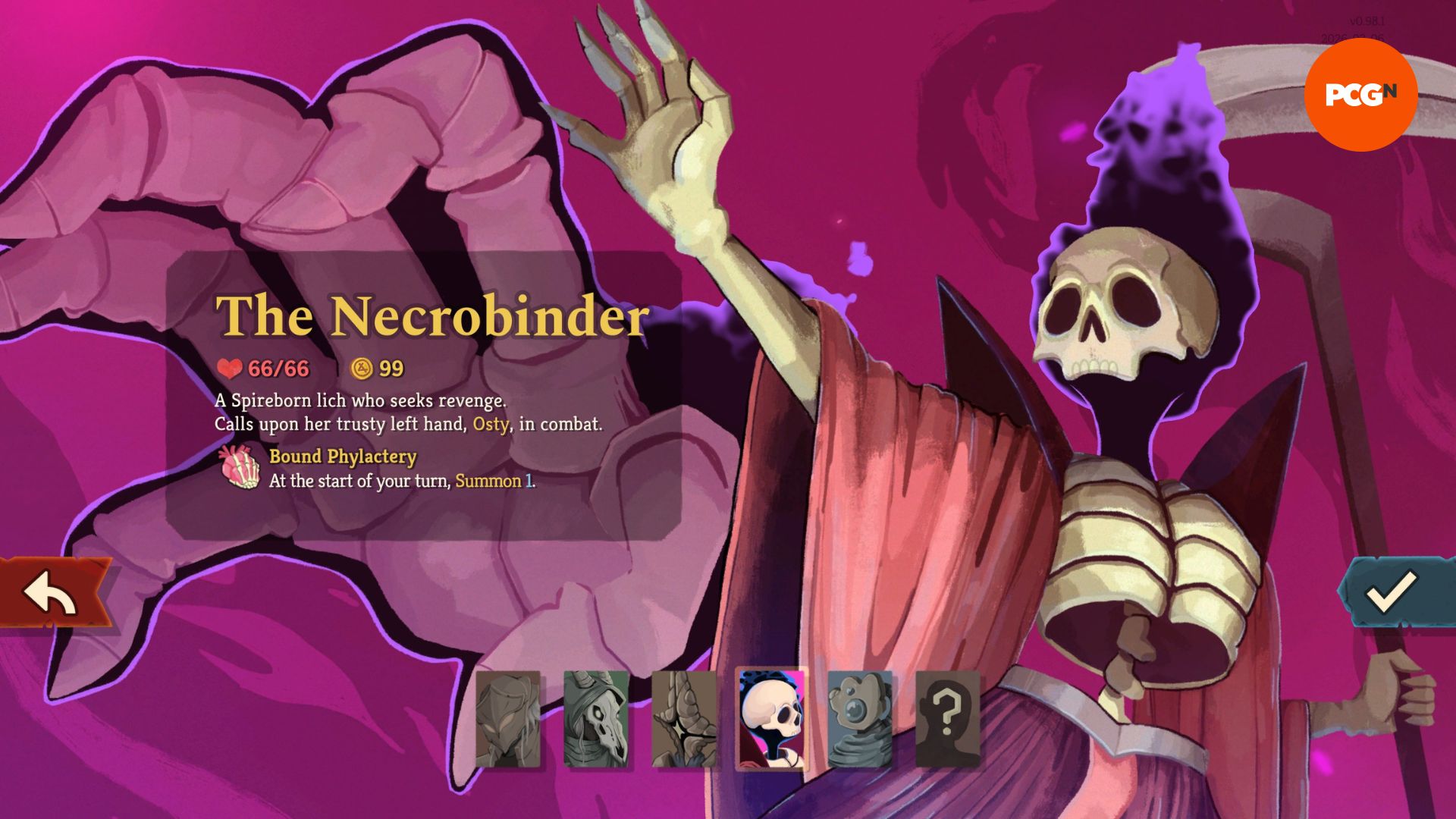
Necrobinder is the most mechanically dense character in STS2 — a new class with three interlocking systems: Doom (execution threshold), Souls (0-cost token cards), and Osty (skeletal companion). The floor is punishingly low but the ceiling rivals Silent.

Necrobinder character portrait in Slay the Spire 2
Necrobinder is a new character built around Doom execution, Soul tokens, and the Osty companion.

Necrobinder is the character you play when you want mechanical depth above everything else. No other class asks you to track as many moving parts: Doom stacks on enemies that execute at a threshold, Souls are 0-cost tokens that cycle your deck and trigger payoffs, and Osty is a companion that tanks damage and re-summons on death. These three systems interact constantly — Doom kills generate Souls, Souls fuel Exhaust triggers, and Osty buys time for the setup.

The community ranks Necrobinder A tier. The ceiling is very high (Soul/Haunt engine deals unavoidable HP loss that bypasses Block entirely), but the floor is punishingly low (you can die in Act 1 if you mismanage Osty or commit to Doom against the wrong enemy). This is not a beginner character. Play Ironclad first to learn the sequel's universal systems, then Necrobinder once you want the game's most tactical combat.

Verification note

Cross-verified against Mobalytics, Untapped.gg (88 cards confirmed), Chinese community (17173, GamerSky), and Japanese sources (Gamerch, GameWith).

What to focus on with Necrobinder

This guide is built to answer three things fast: what is confirmed about Necrobinder, what makes the class feel different, and what matters in the first few runs.

Think of it as a first-pass class read before you move into build ideas, mechanic explainers, or deeper matchup talk.

Start here before you jump into build speculation or tier lists.

Open the linked mechanics pages if Necrobinder depends on a signature keyword or resource system.

Treat this as an early access primer, not a final meta verdict.

How Doom works

Doom is a debuff applied to enemies. It stacks without limit and does not decay between turns. At the end of the enemy's turn, if their current HP is at or below their Doom value, they are instantly executed — removed from combat regardless of remaining HP, Block, or status effects. This is a threshold check, not damage: the enemy simply dies if the condition is met.

The math: if an enemy has 100 HP and you apply 40 Doom plus deal 61 damage in one turn, the enemy drops to 39 HP. Since 39 is at or equal to 40 Doom, they are executed at end of their turn. You did not need to deal 100 damage — you needed to push their HP below the Doom line. This is fundamentally different from damage-based win conditions and changes how you evaluate every card.

No Escape (1 cost: apply 10 Doom plus 5 per 10 existing Doom) creates exponential stacking. First play: 10 Doom. Second play: 15 (10 base plus 5 for the existing 10). Third play: 22 (10 plus 5 for the first 10, plus 5 for the second 10, rounded). Scourge (1 cost: 13 Doom, draw 1) is the bread-and-butter efficient application. Apocalypse (3 cost: 29 Doom, resolves instantly) is the only card that skips the end-of-enemy-turn check — critical against bosses that can heal or have lethal attacks queued.

How Souls work

Souls are 0-cost token cards that read 'Draw 2 cards. Exhaust.' They are generated by various Necrobinder cards and added to your draw pile, discard pile, or hand depending on the source. When you play a Soul, it draws 2 cards and then Exhausts itself (removed for the rest of combat). Souls are not in your starting deck — they are created during combat.

Souls serve three purposes simultaneously. First, they thin your deck by Exhausting after use, meaning your remaining draws become more concentrated. Second, they trigger on-Exhaust effects like Haunt (each Soul played causes a random enemy to lose 6 HP) and any other Exhaust payoff. Third, they cycle your hand — drawing 2 cards for 0 energy is the best draw rate in the game.

The Soul density determines your build's power curve. In a 20-card deck with 5 Souls, roughly one in four draws is a Soul that cycles for free. In a 10-card deck with 8 Souls, you are effectively playing your entire deck every turn. The goal of most Necrobinder builds is to thin the non-Soul cards through Exhaust while generating more Souls, creating a positive feedback loop that accelerates every turn.

How Osty works

Osty is a skeletal hand companion that starts each combat in play thanks to Bound Phylactery (starting relic). Osty has separate HP from you and takes damage before it reaches you — functioning as a meat shield. When Osty's HP reaches 0, he dies. At the start of your next turn, Osty re-summons at 1 HP. If Osty survives a full enemy turn without dying, he gains +1 HP permanently for that combat.

In practice, Osty dies frequently in Act 1 because 1 HP is not enough to survive most attacks. This is normal and expected. His value comes from two things: absorbing the first hit of multi-attack enemies (saving your HP), and creating a death event that triggers Soul-generation cards. Cards that interact with Osty include Pull Aggro (add HP to Osty plus gain Block) and cards that trigger on companion death.

At high Ascension, managing Osty's death timing becomes strategic. Some boss attack patterns have a weak hit followed by a strong hit — if Osty absorbs the weak hit and dies, you take the strong hit directly. Against those bosses, sometimes letting Osty die early on your own terms (by not healing him) is better than trying to keep him alive. This kind of death-timing decision is what makes Necrobinder the most tactically demanding character.

Starting relic and Act 1 decisions

Bound Phylactery summons Osty at combat start. In Act 1 hallway fights, Osty absorbs 1 hit then dies — this is effectively 1 free Block every combat, scaling up as Osty's HP grows. The relic's hidden value is enabling companion-death triggers from turn 1, which feeds Soul generation.

Act 1 card priorities: take Exhaust enablers (Dark Pact, any low-cost Exhaust card) over flashy Doom cards. The research data consistently shows that prioritizing Exhaust cycling in Act 1 improves win rate by roughly 40 percent compared to forcing a Doom-first approach. Doom requires enemies with enough HP to make threshold math matter — Act 1 hallway enemies die to regular damage before Doom becomes relevant.

Do not force a specific archetype in the first 5 card rewards. Take good cards regardless of build path. Necrobinder's three archetypes (Soul/Haunt, Exhaust Cycling, Doom) share many cards in common, so early picks rarely lock you into a path. The deck tells you which direction it wants by mid-Act 1 based on which Rares and Uncommons appear.

Energy economy and turn sequencing

Necrobinder starts with 3 energy and draws 5 cards. Souls cost 0 energy, which means a hand with 2 Souls and 3 regular cards effectively gives you 7 cards of value for 3 energy. As Soul density increases, the effective hand size grows well beyond 5. In late-game thin decks, a single turn might involve playing 5+ Souls interspersed with 2-3 regular cards for 10+ total plays.

Turn sequencing on Necrobinder matters more than on Ironclad but less than on Silent. The core pattern: play Souls first (they draw more cards and might find your key plays), then assess whether to apply Doom, Exhaust for engine value, or Block for survival. Playing Souls first is almost always correct because they cost 0, draw 2, and might draw into the exact card you need.

The exception is when Haunt is active. With Haunt (each Soul played causes enemy HP loss), playing Souls first is both the draw engine AND the damage engine. A hand of 3 Souls with 2 Haunts active deals 36 unavoidable HP loss (6 HP × 2 Haunts × 3 Souls), draws 6 cards, and costs 0 energy. The remaining 3 energy goes entirely to Block and setup. This is why the Soul/Haunt engine is rated S tier.

Boss matchups

Necrobinder excels against high-HP bosses where Doom threshold math creates efficient kills. Knowledge Demon has one of the largest HP pools — Doom reduces the effective kill requirement by the entire Doom stack, meaning you might only need to deal 60 percent of the boss's HP in actual damage. The Queen does not reset debuffs between phases, so Doom carries through — this is one of Necrobinder's strongest matchups.

Necrobinder struggles against Insatiable because the instant-death timer conflicts with Doom's slow setup. Doom checks at end of enemy turn, and if Insatiable kills you before then, the Doom never triggers. Against Insatiable, pivot to Soul/Haunt damage (which resolves immediately on your turn) instead of Doom stacking.

Ceremonial Beast (Act 1a) is dangerous because early Necrobinder decks lack the card quality to both set up Doom AND survive. Kin Priest's healing counters slow Doom application — use Doom multiplication cards (No Escape) to outscale the healing rather than trying to apply Doom gradually. Kaiser Crab's Block does not interact with Doom at all (Doom checks HP, not Block), making Kaiser Crab one of Necrobinder's easiest Act 2 matchups.

Co-op role and team synergy

In co-op, Necrobinder is the debuff specialist. Doom stacks do not expire and apply to specific enemies, so Necrobinder can mark high-HP targets for execution while teammates handle other threats. Haunt's unavoidable HP loss bypasses all enemy defenses, making Necrobinder the best counter to high-Block enemies in a team setting.

The best two-player combination is Necrobinder plus Ironclad. Ironclad tanks and keeps Necrobinder alive through the fragile setup turns, while Necrobinder provides a unique kill mechanic (Doom execution) that Ironclad cannot replicate. The highest-burst two-player pair is Necrobinder plus Regent — Osty absorbs damage while Regent's Stars engine builds toward an explosive Seven Stars turn.

Avoid pairing Necrobinder with Defect in co-op. Both characters have high setup costs, low early survivability, and no natural tanking. The combination frequently dies to Act 1 elites before either engine comes online.

Build paths at a glance

Necrobinder has three main archetypes. Soul/Haunt Engine (S tier) uses Haunt to convert 0-cost Soul plays into unavoidable HP loss that bypasses Block — the most unique win condition in the game. Exhaust Cycling (S- tier) thins the deck to 5-10 cards through Exhaust and replays key cards every turn — the most stable build and the best for learning the class. Doom Execution (A+ tier) stacks Doom via No Escape's exponential scaling to execute bosses at HP thresholds — the highest boss-killing ceiling but requires surviving long enough for the math to work.

For detailed card lists, relic synergies, and combo math for each archetype, see the Necrobinder Builds page.

Common beginner mistakes

Forcing Doom in Act 1. Doom requires enemies with enough HP for threshold math to matter. Act 1 hallway enemies die to regular damage in 3-4 turns — Doom adds nothing. Build Exhaust cycling and take Doom cards if offered, but do not skip strong non-Doom cards while hoping for No Escape.

Trying to keep Osty alive at all costs. Osty dying is part of the design. He re-summons next turn at 1 HP. Spending 2 energy on Pull Aggro to save a 1 HP Osty against a 20-damage attack is usually worse than letting him die and spending that energy on damage or Block for yourself.

Ignoring deck size. Necrobinder's power scales inversely with deck size. A 30-card Necrobinder deck cycles slowly, sees key cards infrequently, and wastes Souls on draws that find mediocre cards. Target 15-20 cards by Act 2. Below 10 cards, you hit pseudo-infinite territory where you play your entire deck every turn.

Taking Quest Cards. Quest Cards are dead draws that break cycling tempo. In a Necrobinder deck built around Souls and Exhaust, a Quest Card sits in hand taking up space that a Soul or cycling card should occupy. Skip Quest Cards unless the reward is exceptionally strong.

Comparison

What this class adds that Slay the Spire 1 never had

Necrobinder is not an update to an old class slot. It is a new class fantasy with mechanics that did not exist in the first game's launch roster.

FAQ

What is the difference between Doom and Poison?

Poison deals damage equal to the stack each enemy turn and then decreases by 1. Doom does not deal damage — it is a threshold check. If the enemy's HP is at or below the Doom value at end of their turn, they are executed instantly. Doom does not decay. They serve different strategic roles: Poison is a ticking clock, Doom is a line you push the enemy below.

Does Haunt damage bypass Block?

Yes. Haunt causes enemies to lose HP directly, not take damage. Block does not prevent HP loss. This is why Soul/Haunt is one of the most unique win conditions in Slay the Spire 2.

Should beginners play Necrobinder?

Not as a first character. Necrobinder asks you to manage Doom thresholds, Soul cycling, Osty timing, and Exhaust counts simultaneously. Play Ironclad first to learn the universal systems, then Necrobinder when you want the deepest tactical combat in the game.

Why is Dead Branch best-in-slot for Necrobinder?

Dead Branch generates a random card each time a card is Exhausted. Necrobinder Exhausts more cards than any other character (Souls, Dark Pact, cycling). Dead Branch converts this into 20+ new cards per turn, overwhelming enemies with volume. Note: Dead Branch was removed from Ironclad but remains available as a general relic.