Back to Characters
Character GuideVerified March 10, 2026

Defect

Defect is the most redesigned returning character. Permanent Focus stacking is gone — replaced by temporary spike turns through Synchronize. The Claw 0-cost build ignores Orbs entirely and is the class's strongest archetype. Commit to Claw or Orbs by mid-Act 1; mixing kills both.

Defect character portrait in Slay the Spire 2
Defect is the most redesigned returning character, with permanent Focus stacking replaced by temporary spike turns.

Defect is the character that changed the most from STS1 to STS2. If you played Defect in the original game, your instincts about Focus stacking, Orb management, and long-game scaling are likely wrong in the sequel. The single most important thing to understand is that permanent Focus accumulation is gone. Consume is deleted, Defragment is now Rare, and Biased Cognition is restricted to Ancient rewards.

The community ranks Defect last among the five launch characters, but this is partly a perception problem. The Claw 0-cost build — which ignores Orbs entirely — is S-tier and competitive with the best builds from any character. The issue is that Orb builds are less consistent because they depend on finding specific card combinations for all four Orb types. Players who commit to one path early perform significantly better than those who try to hedge.

Verification note

Cross-verified against Mobalytics, GAMES.GG, Sportskeeda, Untapped.gg card data, and community consensus. 89 cards confirmed.

What to focus on with Defect

This guide is built to answer three things fast: what is confirmed about Defect, what makes the class feel different, and what matters in the first few runs.

Think of it as a first-pass class read before you move into build ideas, mechanic explainers, or deeper matchup talk.

Start here before you jump into build speculation or tier lists.

Open the linked mechanics pages if Defect depends on a signature keyword or resource system.

Treat this as an early access primer, not a final meta verdict.

How the Orb system works in STS2

Defect channels Orbs into Orb slots. Each Orb type has a passive effect (triggers at end of turn) and an Evoke effect (triggers when the Orb is pushed out by a new one or forcibly evoked). Focus increases both the passive and Evoke damage of Lightning and Frost Orbs by a flat amount per Focus stack. There are four Orb types in STS2: Lightning (passive: 3 damage to random enemy; Evoke: 8 damage), Frost (passive: 2 Block; Evoke: 5 Block), Dark (passive: gain 6 damage per turn, stacks; Evoke: deal all accumulated damage to lowest-HP enemy), and Glass (new — passive: deal Scratch Damage to all enemies; Evoke: deal larger Scratch Damage to all).

The critical STS1-to-STS2 change: Focus is now temporary, not permanent. Synchronize (1 cost, Skill: gain 2 Focus per unique Orb type channeled for this turn only) is the primary Focus source. With all four Orb types active, Synchronize gives +8 Focus for one turn. The design intent is clear — Defect plays spike turns rather than slowly accumulating an unstoppable Focus lead.

Dark Orbs no longer scale with Focus. They accumulate damage passively over time regardless of Focus, making them the only Orb type that rewards slow play. Plasma Orbs (gain Energy on Evoke) are also unaffected by Focus. This means Focus only amplifies Lightning and Frost — two of the four types — which further concentrates the Orb build around Synchronize burst turns.

Why Claw ignores all of this

Claw (0 cost: 3 damage, all future Claws deal 2 more permanently) scales through play count, not Focus or Orbs. The Claw deck runs zero Orb cards and instead fills the deck with 0-cost Attacks: FTL (0 cost: damage plus draw 1), Beam Cell (0 cost: apply Vulnerable), Go for the Eyes (0 cost: apply Weak), and Hologram+ (upgraded to 0 cost: retrieve a card). All for One (2 cost: play all 0-cost cards from discard) is the payoff that replays the entire suite.

This matters because the Claw build avoids Defect's main weakness: Orb RNG dependence. You do not need to find all four Orb types or a Rare Synchronize. You need Claw, some 0-cost cards, and All for One — all of which are Common or Uncommon rarity. The build is more consistent, comes online faster, and does not require any particular relic synergy.

Feral (2 cost, Uncommon Power: first 0-cost Attack each turn returns to hand) is the STS2 card that elevated Claw from a meme build to an S-tier strategy. Before Feral, Claw builds depended entirely on All for One to replay cards. Feral guarantees Claw comes back every turn passively, meaning even if you do not draw All for One, the damage engine keeps running.
Starting relic and Act 1 decisions

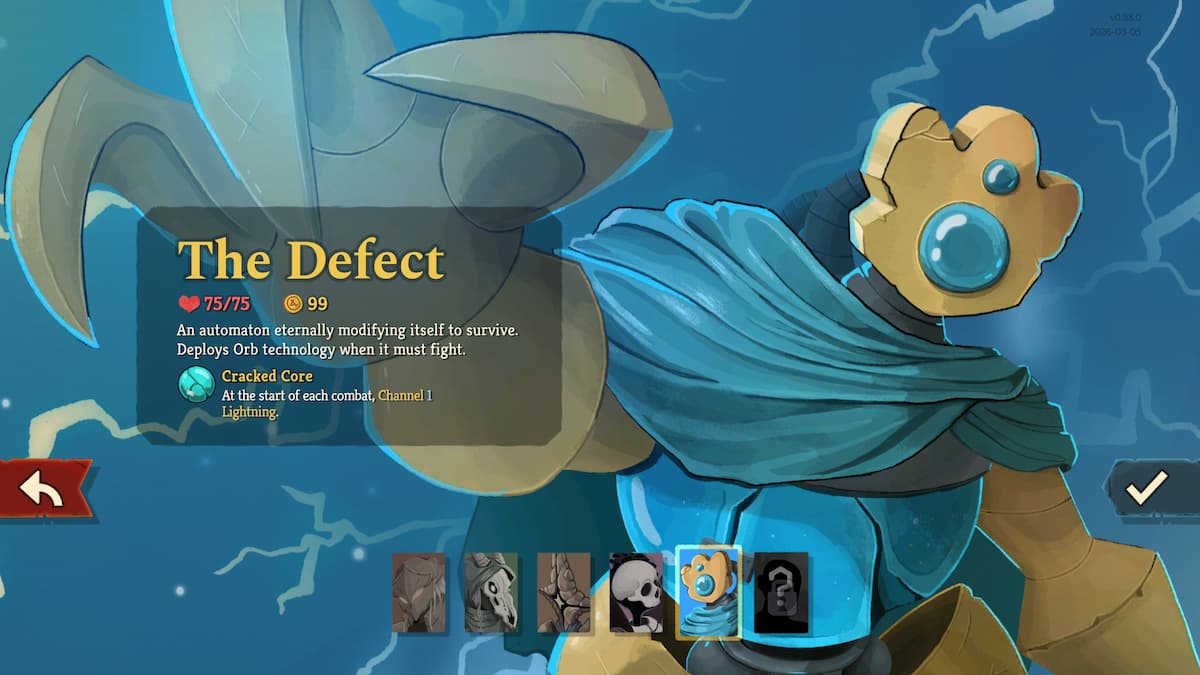
Cracked Core channels 1 Lightning Orb at the start of each combat if you have an empty Orb slot. This gives Defect 3 free damage per turn passively from turn 1 — a small but consistent advantage in Act 1 hallway fights. If you go Claw, the Lightning Orb is still free value but becomes irrelevant by Act 2. If you go Orbs, it seeds your first slot.

The most important Act 1 decision is whether to go Claw or Orbs. If your first few card rewards include Claw, FTL, or Go for the Eyes, commit to Claw and avoid Orb cards. If you see , , or , commit to Orbs. Taking both Claw cards and Orb cards in Act 1 is the most common Defect mistake — it weakens both paths because your deck becomes unfocused.

First campfire: upgrade Zap (channels 1 Lightning Orb) if going Orbs, or upgrade your first 0-cost Attack if going Claw. Rest only if below 35 HP — Defect's 75 HP is mid-range and does not have Ironclad's healing cushion, but it is not as fragile as Silent.

Energy economy and turn sequencing

Defect starts with 3 energy and draws 5 cards. Orb builds play differently from Claw builds. An Orb turn: channel Orbs first (to fill slots and trigger Cracked Core replacement), then play Synchronize for the Focus spike, then Evoke for amplified effects. A Claw turn: play all 0-cost cards, then All for One to replay them, then play them again. Claw turns tend to involve 8-12 card plays; Orb turns involve 3-5 focused plays.

Plasma Orbs solve Defect's energy problem. Evoking a Plasma Orb gives 1 energy (2 with Focus from Synchronize). Synthesis (2 cost: 24 damage, channel 3 Plasma) is the primary Plasma source. If you find Synthesis early in an Orb build, energy stops being a constraint because Evoking Plasma Orbs while cycling through Orb slots generates net-positive energy.

Claw builds have a different energy profile: most cards cost 0, so the 3 base energy goes entirely to All for One (2 cost) and Power setup (Feral at 2 cost). Once Powers are online, Claw turns cost 2 energy maximum and the rest is free play. This is why Claw feels more fluid than Orb builds in practice.

Boss matchups

Defect performs best against multi-enemy encounters because Lightning-heavy Orb turns and Glass Orbs deal AoE passively. Soul Fysh (Act 1b) summons minions that Lightning Orbs chip down between turns. Kaiser Crab alternates between attack and defense phases — Claw builds ignore the defense phase because Claw play count keeps accumulating regardless.

Defect struggles most against The Queen (Act 3) because card binding limits you to 2 plays per turn. Claw builds depend on playing many cards — being limited to 2 is devastating. Orb builds handle The Queen better because Orb passive effects continue working even when card plays are restricted. This is one of the few matchups where Orbs clearly outperform Claw.

Insatiable (Act 2) requires fast damage, which Claw delivers from turn 1. Orb builds need 2-3 turns to set up Synchronize burst, which may not be fast enough against the instant-death timer. Against Knowledge Demon, both paths work — Claw grinds the large HP pool down through play count, and Orb builds burst with Dark Orb accumulated damage.

Co-op role and team synergy

Defect fills the AoE specialist role in co-op. Lightning-heavy Orb turns, Glass Orbs, and Claw backed by (10 AoE damage per 5 cards played) give Defect the most consistent multi-target damage outside of Ironclad's Whirlwind. In a balanced team, Defect handles minion waves while the single-target specialist (Silent or Necrobinder) focuses bosses.

The best Defect partner in two-player is Ironclad: Ironclad tanks and applies Vulnerability, Defect deals AoE. In four-player, Defect plus Regent is strong because Regent's Stars utility complements Defect's damage focus and neither character competes for the same card pool.

Defect pairs poorly with Necrobinder because both characters have high setup cost and neither provides reliable early defense. Two high-setup characters in co-op often die to Act 1 elites before either engine comes online.

Build paths at a glance

Defect has three main archetypes. Claw Spam (S tier) scales through 0-cost Attack cycling with Feral providing guaranteed card return — the most consistent build and the one least affected by card RNG. Synchronize-Shatter Burst (A+ tier) channels all four Orb types and uses temporary Focus spikes for massive single turns — the intended STS2 Defect design. Lightning-Frost Hybrid (A+ tier) uses and for Lightning pressure plus for Frost defense — the safest Orb build with as a scaling finisher.

For detailed card lists, relic synergies, and combo math for each archetype, see the Defect Builds page.

Common beginner mistakes

Mixing Claw and Orb cards. This is the single most damaging Defect mistake. Claw cards dilute Orb draw consistency and Orb cards waste energy that Claw does not need. Commit by the end of Act 1.

Treating Focus like STS1. Do not draft cards hoping to permanently stack Focus. It does not work anymore. Build around Synchronize burst turns instead. If you catch yourself thinking 'I just need more Focus,' you are playing STS1 Defect in a STS2 game.

Taking Scrape in Claw builds. Scrape draws 4 cards but discards all non-Attacks drawn. All for One costs 2 — if Scrape draws it, All for One gets discarded. Use Hologram+ (upgraded to 0 cost) for card retrieval instead.

Ignoring Glass Orbs. Glass Orbs are new and unfamiliar, but they provide AoE and are the fourth Orb type needed for maximum Synchronize Focus. Skipping Glasswork and Spinner weakens Synchronize from +6 to +8 Focus, which is a 33 percent damage difference on burst turns.

Changes from Slay the Spire 1

The Focus rework is the defining change. Permanent stacking through Defragment and Biased Cognition is replaced by temporary spikes through Synchronize. This shifts Defect from a late-game scaling class to a mid-game burst class. Dark Orbs now scale with time instead of Focus, making them the only slow-growth option.

Consume is deleted. Defragment is now Rare (was Uncommon in STS1). Biased Cognition is restricted to Ancient rewards only — you cannot draft it from normal card rewards. Glass Orbs are a completely new Orb type with AoE functionality. Feral is the new Uncommon Power that makes Claw builds genuinely strong instead of meme-tier.

Specific card changes: Rampage base damage 8 to 9, Calculated Gamble upgrade now gives Retain (no longer removes Exhaust), Synthesis is new (2 cost: 24 damage plus channel 3 Plasma). Momentum Strike is new (starts at 1 cost, permanently becomes 0-cost after first play).

Comparison

What changed from Slay the Spire 1

Defect returns, but the public reveal trail around the class is much thinner than it is for Silent, Necrobinder, or Regent. That alone changes how confident players should be at launch.

Reasonable launch-build readCharacter

Most important difference

Slay the Spire 1

The first game eventually produced very stable old habits around Defect's familiar shell.

Slay the Spire 2

The sequel gives you the class name without an equally detailed official class article, which means caution has to replace certainty.

Why it matters

A familiar name with limited reveal data is exactly how players over-import old assumptions.

FAQ

Why is Defect ranked last?

Orb builds depend on finding specific cards for all four Orb types, which makes them less consistent than other characters' primary builds. The Claw build avoids this problem but is less flashy. The character is not weak — it is inconsistent at the roster level. Individual Claw runs are S-tier.

Should I play Claw or Orbs?

Let Act 1 card rewards decide. If you see Claw, FTL, or Go for the Eyes early, go Claw. If you see , , or early, go Orbs. Do not hedge — committing to one path by the end of Act 1 is the most important Defect decision.

Can I still stack Focus permanently?

No. Consume is deleted, Defragment is Rare, and Biased Cognition is Ancient-only. Synchronize gives temporary Focus (+2 per unique Orb type) for one turn. Build around spike turns, not accumulation.

Is Defect good for beginners?

Medium difficulty. The Claw build is straightforward (play 0-cost cards, play All for One, repeat), but the Orb build requires understanding four Orb types, Focus timing, and Evoke priorities. Start Claw for simplicity, then experiment with Orbs.